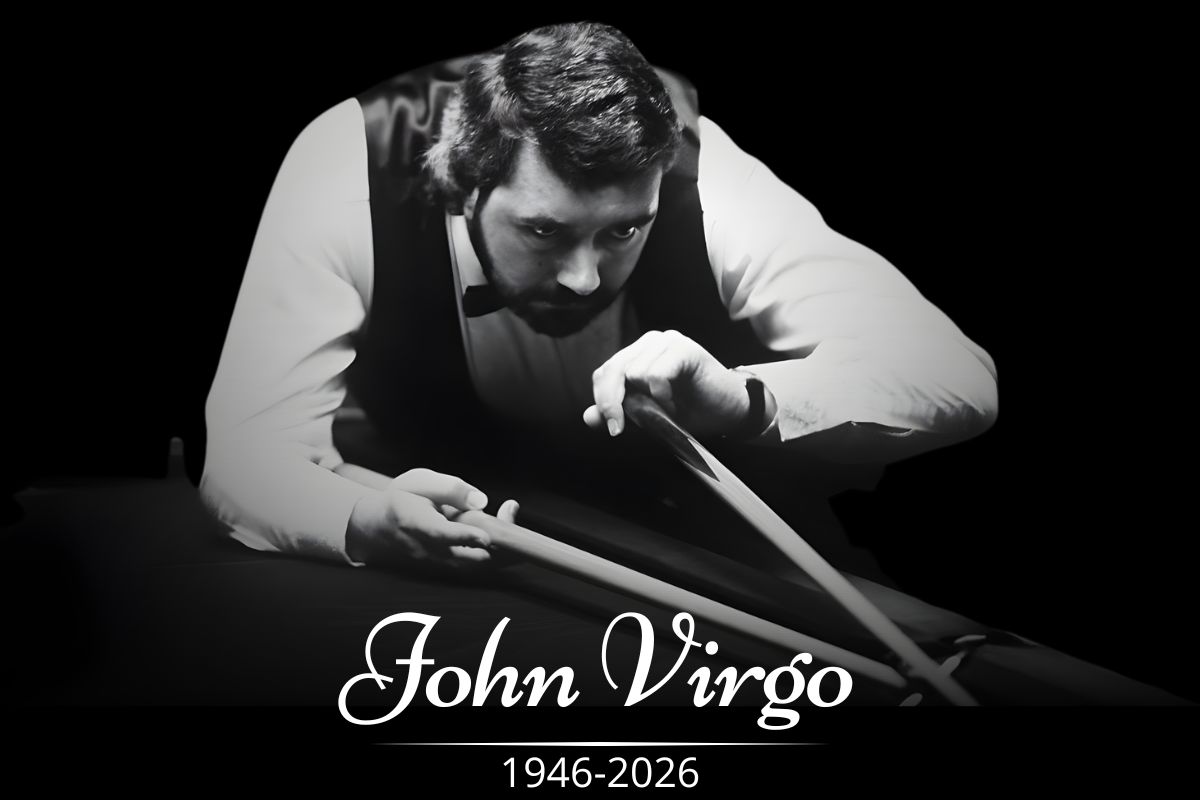
I’m sitting here on a cold Thursday morning, tea beside me, completely forgotten and now cold, just watching the news updates roll in. It still doesn’t feel fully real. John Virgo, the Salford voice so many people link with snooker on TV, has passed away. The confirmation came through on Wednesday, February 4, 2026. He was 79. It’s a strange feeling when someone who has just always “been there” suddenly isn’t anymore.
I’ve been following the game since the days when the air in the Crucible was thick with cigarette smoke and the waistcoats were even more garish than they are today. For a lot of viewers raised on Big Break and the BBC tournaments, JV felt less like a broadcaster and more like familiar company. He had that way of talking that made even a slow frame feel important.
You never felt talked down to. You felt included. So when people started asking what happened and how did John Virgo die, it felt worth putting proper words to it instead of just another quick post or headline.
The Quiet Morning in Spain
The news broke through the World Snooker Tour and quickly filtered out to the BBC and The Guardian. John passed away at his home in Spain, right on the Costa del Sol. He’d moved out there around 2020.
Honestly, if you’ve ever dealt with the kind of damp, bone-chilling cold we get in Salford or Sheffield in the winter, you’d understand why. He had a longstanding neck injury—the kind of nagging, persistent pain that comes from decades of leaning over a slate bed—and the Mediterranean heat was his version of medicine.
Now, most people are asking the same thing straight away. What actually happened? What was John Virgo’s cause of death? The truth is, there isn’t some dramatic story behind it.
As of February 5th, no detailed medical statement has been shared.
The family has kept it private, which feels fair. Not every loss needs to be turned into a headline with footnotes and speculation. There was no widely reported John Virgo illness doing the rounds in the months before. He was 79, at home, and with his wife, Rosie. Sometimes it’s simply that quiet.
What really stays with me is how switched on he remained right to the end. Just over two weeks before his passing, he was still doing what he loved, up in the commentary position at Alexandra Palace for the 2026 Masters final. Seventeen days. That’s it. Still sharp, still spotting patterns on the table before most viewers even saw the angle. His voice hadn’t lost its lift either.
As Kyren Wilson got the better of John Higgins, he called the key moments the same way he always did, with timing and warmth. Even after all those years, he could still make a single shot feel like it mattered. That takes more than knowledge of the game. That takes heart.
Also Read: Jay Slater Cause of Death: What Happened to the 19-Year-Old Teen in Tenerife?
The Mystery of the Missing Cue Ball
If you close your eyes and think of John, you hear it immediately. “Where’s the cue ball going?” It’s the most famous bit of snooker shorthand in history.
He used to laugh about where that famous line came from. He said he more or less pinched it from “Whispering” Ted Lowe. Ted would say it softly, almost like he was worried for the player, like a gentle nudge rather than a shout. John took the same words and gave them theatre.
He’d hold it back, sometimes for ages, then the white ball would start rolling a touch too fast toward the pocket, and you could almost feel him gearing up. Then out it came, full voice, perfect timing. It turned a quiet shot into a proper moment.
He admitted more than once that he did it on purpose. Not to show off, just to wake the room up a bit. He knew not everyone watching cared about cue angles and safety play. Plenty of people just wanted a spark, a bit of tension, something to react to. So he played that role gladly. Part explainer, part entertainer. The goal was simple. Get people leaning forward instead of reaching for the remote.
The Partnership That Broke the Mould
You can’t talk about JV without talking about Jim Davidson. I remember when Big Break first aired in 1991. It felt like a fever dream—a stand-up comic and a snooker pro running a game show. But it worked. It worked for eleven years.
Are Jim Davidson and John Virgo friends? They were much more than just colleagues. Jim’s tribute yesterday was genuinely moving; he called John his “great mate” and a “character” in every sense of the word. Their chemistry wasn’t scripted fluff.
They were two guys from separate worlds who found a shared language in comedy and a few trick shots. When the two of them were on screen, you felt as though you were eavesdropping on a conversation in a social club. Jim was the lightning, and John was the grounded wire that kept the whole thing from exploding.
More Than Just a Funny Voice
Because he could do those uncanny impersonations — the fidgety little movements of Alex Higgins or the slow, careful groove of Terry Griffiths — a lot of viewers ended up thinking of him rather as an entertainer than a player. The funny voices and table-side stories sometimes stole the spotlight. Easy to forget there was real steel behind the smile.
He joined the pro ranks in 1976 and proved pretty quickly he belonged there. The big one came at the UK Championship in 1979, where he edged past Terry Griffiths in a final that went right to the last frame, 14–13. There was no easy finish or trophy lift. Proper tension. At his best, he climbed to world number 10, which in that era meant you could really play.
He also never tried to polish up the rough bits of his story. He talked plainly about the bad habits he became addicted to that followed him for a stretch. Called it a vicious loop that kept dragging him back in when he should have walked away.
It wasn’t dressed up as a brave confession or a neat lesson. Just the truth as he saw it. The game gave him big nights and silverware, but it also gave him some hard knocks away from the table. The fact he spoke about both sides says a lot about the man.
A Legacy That Sticks
So, where does that leave us? Snooker is in a weird spot now. We’ve lost a lot of the giants recently. But JV felt different because he was the narrator of our collective childhood. He was the one who explained the “kick”, the “plant”, and the “snooker required” moments to us.
He is survived by his wife, Rosie Ries, and his two children, Gary and Brook-Leah. But in a way, he’s survived by anyone who ever picked up a cue and tried to do a trick shot while pretending to be him.
Also Read: Who Was Diogo Jota and How Did He Pass Away?
FAQs: What We Know Now
When did John Virgo pass away?
He died on Wednesday, February 4, 2026. He was 79 years old.
Was he ill before he died?
There were no public reports of a terminal illness. He moved to Spain years ago to manage chronic neck pain, but he was healthy enough to broadcast until mid-January 2026.
Where did he die?
At his home in the Costa del Sol, Spain.
What was his final match in the box?
The 2026 Masters final between Kyren Wilson and John Higgins. He worked right up until 17 days before his passing.
How did he get famous?
First as a UK Champion (1979), then as a beloved BBC commentator and co-host of Big Break.
The table is empty now. The lights are off. And honestly, I’m still wondering… where’s that cue ball going? It feels like it finally found the pocket it was looking for.
Rest easy, JV. You made the game a lot more fun for the rest of us.
Recommended