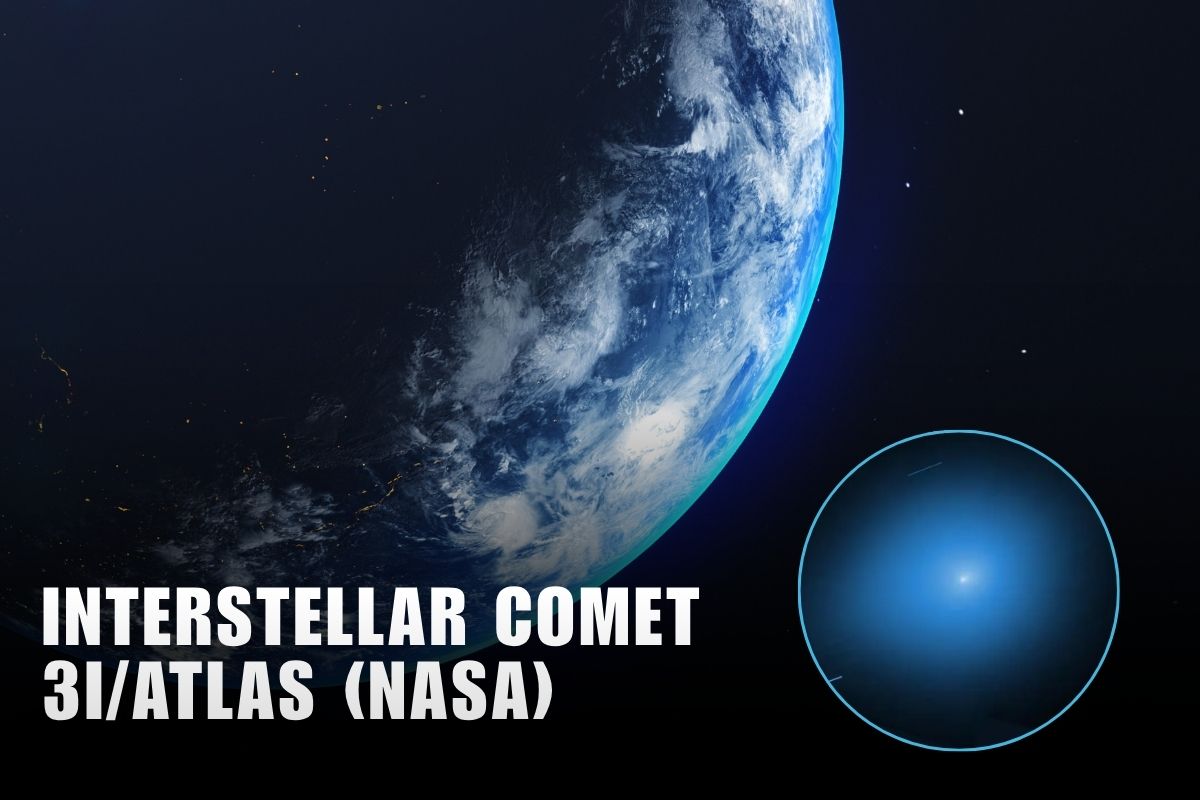
Space isn’t just empty darkness. Once in a while, it throws us a curveball from the literal unknown. It’s March 2026 and astronomers are glued to their monitors as interstellar comet 3i/Atlas/NASA exits our neighbourhood once and for all in a final, spectacular fashion. It’s the third confirmed visitor from another star system, after ’Oumuamua and 2I/Borisov — but it’s strongly pushing back against our understanding of what such visitors ought to be.
The object, dubbed C/2025 N1, was first detected in July 2025. Since then, it’s become something of a local celebrity in the scientific community. But unlike a typical Oort Cloud comet of the sort so often entering our solar system, this particular particle has a chemical signature indicating it was born in a freezer far colder than anything lurking on the outskirts here.
A Flare-Up That Defied Logic
Most comets get steadily quieter after passing the Sun. Their volatile material is consumed, activity wanes, and they slip into darkness. Interstellar comet 3I/Atlas (NASA) missed that memo.
When NASA’s SPHEREx mission turned its infrared gaze back toward the comet in December 2025, it found not a bumbling pile of soft-serve rocks that quit fizzing, but a comet that was even more active than before. The coma held large amounts of carbon dioxide, water, organic molecules and other compounds that had not been so abundant in previous measurements. It had brightened, not dimmed.
Furthermore, scientists found a glow of X-rays from the comet stretching roughly 250,000 miles into space. That wasn’t, again, something anyone was quite expecting. The working theory goes that it took a while for the heat from the Sun to penetrate that rocky outer shell of the nucleus, and once it did, those untouched ices inside went off like fireworks. Billions of years of material from another solar system, releasing itself into ours just before vanishing forever.
Also Read: How Nebius Became the Most Important AI Backend Partner in 2026
The “Drunk” Comet: Why Methanol Matters
The real shocker came from the Atacama Large Millimeter/submillimeter Array (ALMA). In a study published earlier this year, researchers found that 3I/ATLAS is absolutely “bursting with methanol.”
In plain English? This comet is carrying a staggering amount of alcohol.
While methanol is common in space, the levels here are off the charts compared to “local” comets. This is a massive “smoking gun” for astronomers. It tells us that wherever this thing came from—likely somewhere in the direction of the Sagittarius constellation—the conditions were fundamentally different from our own Sun’s birth. It suggests a birth in a region of space that was either chemically richer or significantly more shielded from radiation.
How NASA Tracked a Moving Needle
Following an object going 137,000 mph is not a one-telescope job. A network of high-tech sensors helped piece together this story.
- TESS: Strangely, the Transiting Exoplanet Survey Satellite spotted the comet in May 2025—weeks before anyone figured out what it was.
- Swift Observatory: This mission was the first to detect “water” (hydroxyl gas) being blown out at about 40 kg per second. That is a lot of ice to turn to steam in a very short time.
- James Webb (JWST): The big eye in the sky gazed at the “coma” (the fuzzy bit around the rock) and saw that it was dominated by carbon dioxide even when still egregiously far from the Sun’s warmth.
- Hubble: By analysing the light bouncing back from that solid core, scientists were able to estimate its size: between 440 metres and 5.6 kilometres across.
The Mars Reconnaissance Orbiter also participated in the event, taking pictures from its Martian orbit while observing the comet speed past the Red Planet in October 2025.
The Rare “Anti-Tail” Phenomenon
On 22nd January, 2026, something very stunning happened. The Sun and 3I/ATLAS were in a rare “opposition” alignment, with Earth positioned directly between them. This placed Hubble in a front-row position to witness an optical illusion known as “anti-tail.”
While comet tails mostly point away from the Sun, this anti-tail seems to extend toward it. In truth, it was merely a trail of larger dust particles that the comet left behind, but given our particular angle with the cosmic traveller back in January, it appeared like a glowing spear through the void.
Also Read: The Importance of User-focused Web Design and Development
Why It’s Never Coming Back
If you didn’t see it, there’s bad news. 3I/ATLAS is on a hyperbolic path. In math terms, its eccentricity is about 6.1. Anything over 1.0 means the object has enough speed to escape the Sun’s gravity forever.
It’s a one-way trip. This frozen time capsule is currently exiting our system at a blistering pace, carrying its secrets back into the interstellar void. It’s a bit of a bittersweet moment for researchers; we’ve had just enough time to realise how strange it is, only for it to vanish into the black.
Quick Facts: 3I/ATLAS at a Glance
| Feature | Detail |
| Current Speed | ~137,000 mph |
| Origin | Direction of Sagittarius |
| Key Chemical | High Methanol (Alcohol) |
| Discovery Date | July 2025 |
| Status | Exiting Solar System (Hyperbolic) |
Frequently Asked Questions
Is 3I/ATLAS a threat to Earth?
No. It has already made its closest approach and is now moving away toward the outer solar system. It never posed a collision risk.
How is it different from ‘Oumuamua?
‘Oumuamua was dry and didn’t show a visible “tail”, leading to lots of wild theories. 3I/ATLAS is very much a “”classic”-looking comet with a huge coma and tail, just with a very weird chemical makeup.
Can we see it with a backyard telescope?
At this stage in March 2026, it is fading rapidly as it moves past Jupiter. You’d need a very high-end professional or serious amateur setup to spot it now.
Where did it come from?
Based on the trajectory, it came from the direction of the constellation Sagittarius — but which particular star system was its home is still unknown.
Why does NASA call it “Interstellar”?
Because its speed and path indicate that it is not bound by our Sun’s gravity. It originated from deep space and will go back there.
The data gathered from interstellar comet 3I/Atlas (NASA) will likely keep scientists busy for the next decade. It’s a reminder that our solar system is just one house on a very long, very diverse street. What else is floating out there waiting to be found?
Hard to say, but if the next one is as “drunk” as 3I/ATLAS, we’re in for a fun ride.
Sources and References
- NASA Science (Solar System Exploration): 3I/ATLAS (C/2025 N1) Official Mission Hub and Image Gallery – Updated March 2026.
- Space.com News: Interstellar Visitor 3I/ATLAS: The “Drunk” Comet Bursting with Methanol. Reported by T. Thompson (February 2026). Methanol Discovery Analysis.
- European Space Agency (ESA): Interactive Trajectory and Hyperbolic Path Mapping for 3I/ATLAS.
- ScienceDaily / Swift Observatory: Water Detection and Outgassing Rates in Interstellar Comet C/2025 N1. Technical Breakdown (January 2026). Water Detection Report.
- arXiv.org (Cornell University): Post-Perihelion Coma Composition and Volatile Ratios of 3I/ATLAS. Scientific Preprint ID: 2603.0491 (March 2026). Spectroscopy Study.
- Jet Propulsion Laboratory (JPL): Small-Body Database Lookup for C/2025 N1 (3I/ATLAS).
Recommended