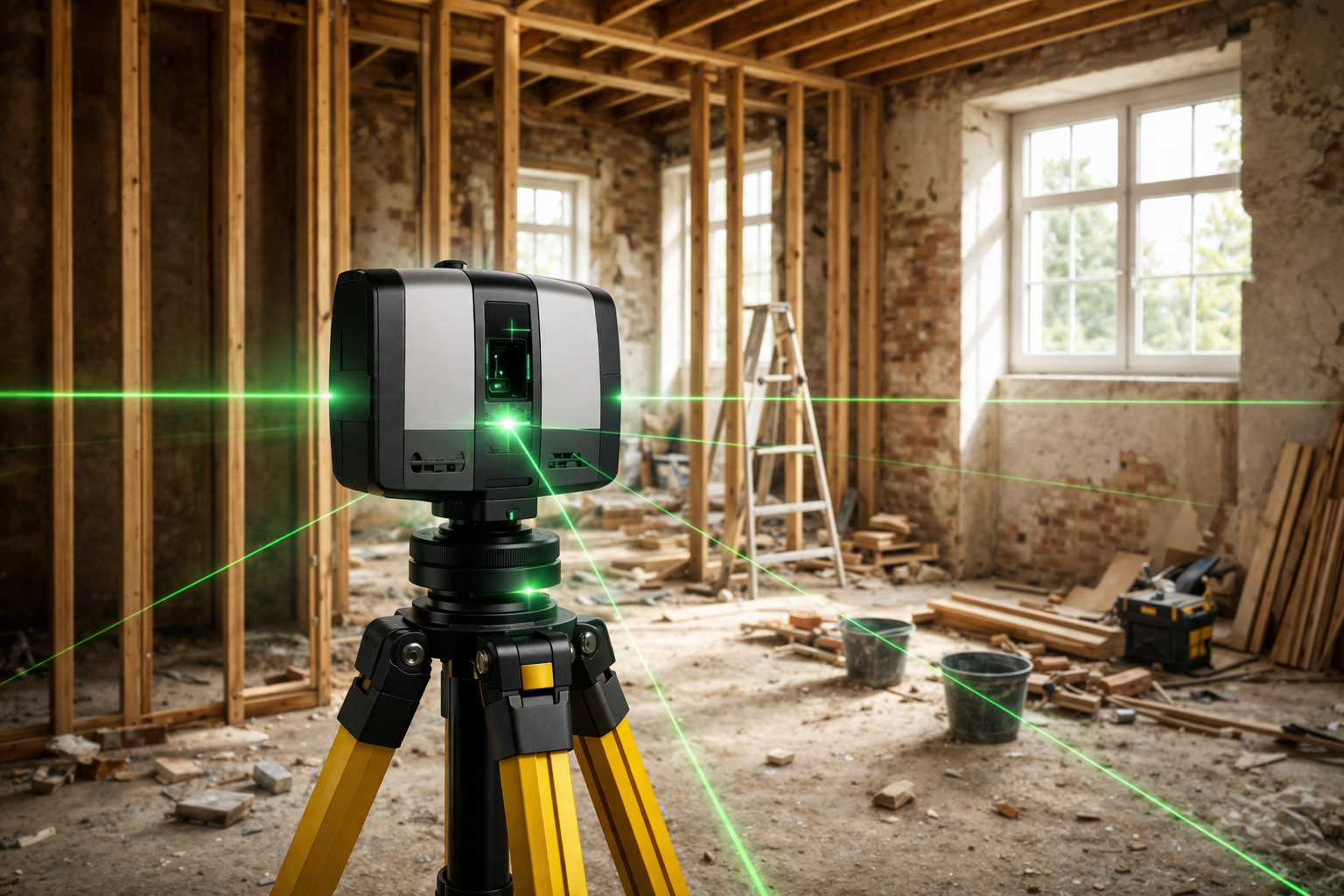
Last Tuesday, I happened to visit a renovation site. It was a 140-year-old Victorian terrace in South London. The house smelled exactly like you would expect. Damp brick, old timber, and something faintly metallic that nobody could quite place. We stood in what the estate agent had called a reception room. A surveyor was setting up what looked like a camera tripod crossed with a science fiction prop. The homeowners had stretched every penny to buy this place. They stood at the doorway, looking somewhere between curious and nervous.
There was a problem with the rear extension they wanted to build. The original drawings from the council archive were decades old, and nobody trusted them. That spinning tripod was our last attempt to understand what we were actually dealing with before committing to a design. That moment was my introduction to laser survey services that turn a scan into a 3D design model. It changed how I think about old buildings entirely.
The Problem Nobody Wanted to Say Out Loud
Renovating Victorian terraces is normal work for a lot of UK architects and contractors. These houses follow a familiar pattern. Two rooms on each floor, a rear addition, and a cellar that floods occasionally. Teams walk in thinking they know what to expect. That familiarity is exactly where things go wrong.
The rear wall had been extended and re-extended over multiple decades. Nobody agreed on where the original structure ended, and the additions began. The homeowners had two contractor quotes on the table. The difference between them was £40,000. Each contractor had made different assumptions about the existing structure. The architect was nervous about submitting planning drawings that might not match reality. The conservation officer had flagged the property for additional scrutiny because it is situated on a locally listed street.
One wrong assumption in the structural drawings could trigger a complete redesign. Or worse, a dangerous demolition decision mid-build. What everyone needed was a single, accurate picture of the building as it actually stood.
What the Scanner Actually Did
The surveyor spent about two hours moving the scanner to different positions around the ground floor, the rear yard, and the first floor. The device was fixed with its tripod and slowly rotated. It keeps on sending out thousands of laser pulses per second to measure the exact distance to every surface it can see. Very much similar to a regular photograph, which records colour and light. This scanner recorded distance instead, from every angle simultaneously.
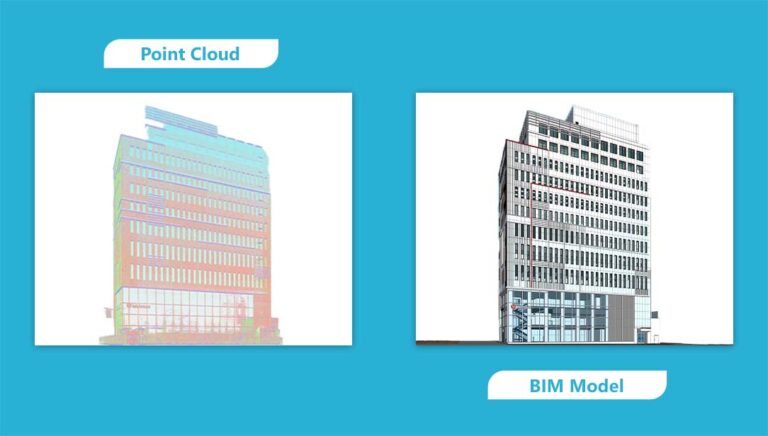
The result was a dense digital map of the building, accurate to within a few millimetres. Every wall, floor, beam, and ceiling exists in it exactly as it does in reality. The BIM team used that data to build a working 3D model. Architects and structural engineers can design directly inside it. That is what 3D laser scanning in architecture actually looks like in practice. Less dramatic than it sounds on site. Most of the work happens back at a desk. But what it produces changes the conversation entirely.
What the Scan Revealed
The model came back four days later. The architect looked at the rear wall first. It was not straight. Across six metres, it bowed outward by almost 90mm at its worst point. No drawing had captured that. No site visit had caught it. The eye does not pick up a gradual curve across a long wall. The scanner did.
The second discovery was worse. A steel beam that contractors had assumed was load-bearing turned out to be a later addition. It was poorly supported. It carried a section of floor directly connected to the proposed extension zone. The structural engineer went quiet when he saw it. The demolition plan for that corner was revised before anyone picked up a tool.
That was the moment I understood the role of 3D laser scanning in real architectural work, and my first reaction was relief. Then came the cold feeling. We had been two weeks from signing a contract that would have walked the builders directly into that beam.
What Changed for the People Involved
The homeowners got one reliable quote instead of two contradictory ones. Their contractor could price accurately because the structural unknowns were gone. That alone closed most of the £40,000 gap between the earlier estimates. It made the project viable.
The architect submitted planning drawings that the conservation officer accepted without a request for amendments. She said afterwards that the quality of the measured drawings made the difference.
Laser scanning for architectural projects cuts rework. The structural engineer did not need a second site visit. The contractor did not discover the bowing wall mid-build and had to stop work. On a project this size, a single unplanned stoppage can cost between £2,000 and £5,000 in idle labour alone.
An Honest Take on the Technology
The thing that impressed me most was how quickly it removed arguments. Every professional on a project carries their own assumptions about an existing building. Those assumptions create friction. When everyone is looking at the same accurate 3D model, that friction disappears.
What annoyed me was the wait. Four days for the model felt long when the project was already under timeline pressure. If you are planning a project, either choose a reputable scan-to-BIM service provider that delivers models faster or add time into your programme before you commission the scan.
Where laser scanning in the construction industry genuinely earns its cost is
- Anywhere the existing structure is uncertain
- Pre-1920 buildings
- Anything with extensions added across multiple decades
- Buildings where original drawings are missing or simply untrustworthy
For a straightforward new-build on a clear site, it may be overkill. For a Victorian terrace with a complicated history, it is almost certainly worth the fee.
What Readers in the UK Should Know
If you are renovating an older home and someone mentions a laser survey, four things are worth knowing:
- Ask whether existing drawings have been verified. If your architect is working from old unverified drawings, ask whether a scan is in scope.
- Commission it early. A scan before design starts is far more useful than one ordered after a problem surfaces on site.
- It does not replace judgment. The scan captures geometry. It does not explain why a wall is bowing or confirm a beam is safe. Experienced people still have to read the model.
- Ask your contractor directly: “Are you pricing from a recent measured survey?” If the answer is no, push on it.
Final Thought
I look at Victorian terraces differently now. Those informal extensions, added decade by decade by different owners with different materials and different ideas about what was structural, are where the surprises live. The scanner did not save that project on its own. The people interpreting what it found made the real decisions. It gave everyone the same, accurate starting point. That is harder to achieve than it sounds, and worth more than most people expect.
Disclosure: The author is not affiliated with the surveying or laser scanning firms involved. This piece is based on an observed renovation project.