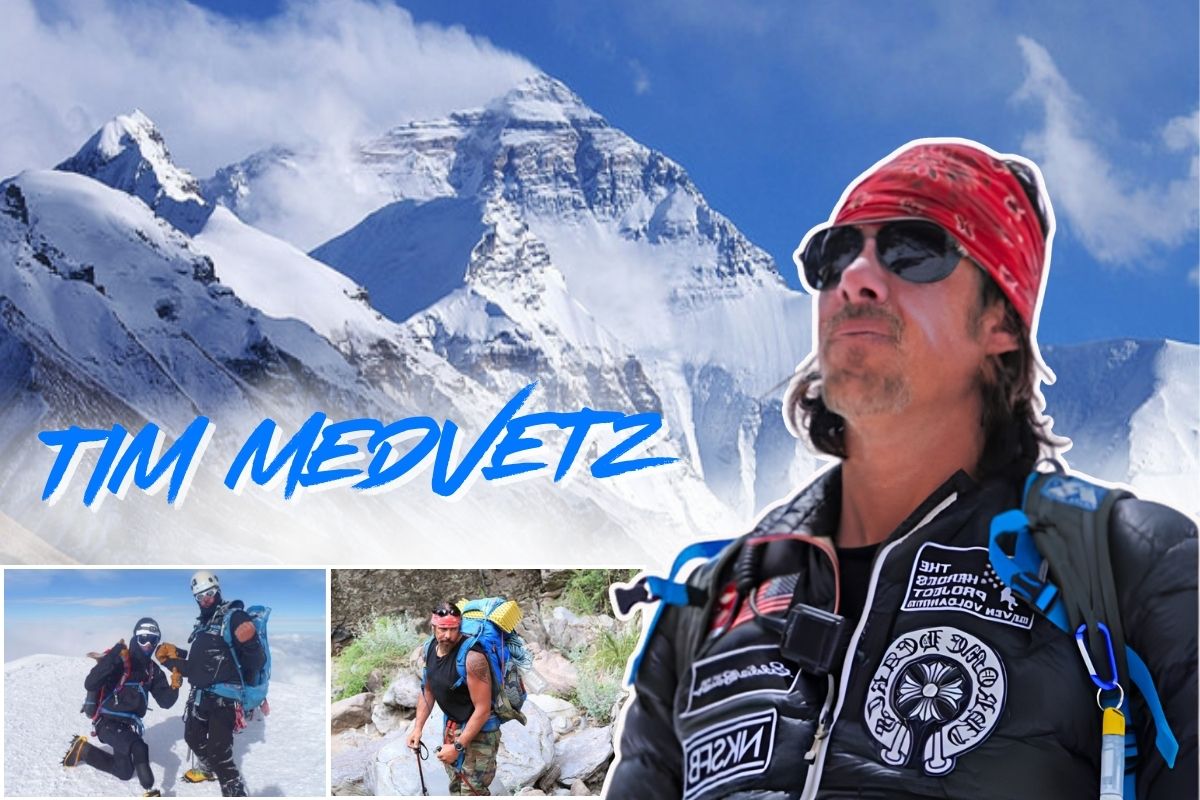
The Tim Medvetz Everest story isn’t the kind you come across very often. A former Hells Angels biker, nearly killed in a motorcycle crash in 2001, left partially paralysed and somehow, a few years later, standing on the roof of the world. He tried once in 2006 and came back without the summit. He tried again in 2007 and made it. Then he took everything that climb taught him and built something far bigger than himself.
- A motorcycle crash on 10 September 2001 left Medvetz partially paralysed, the kind of injuries doctors don’t usually send you home from.
- His first shot at Everest in 2006 ended 300 feet from the top. Not because he quit, but because his oxygen ran out and he knew the math.
- He went back in 2007 and stood on the summit on 21 May, coming up the North side, broken hand and all.
- Discovery Channel had cameras on both climbs for their series Everest: Beyond the Limit, which is how most people first heard his name.
- In 2009, he started The Heroes Project, not a charity in the typical sense, but a nonprofit that takes seriously injured military veterans up the biggest mountains on earth.
- May 2025 marks the next big move: construction started on a permanent Veteran Retreat Center at Mt. Baldy, the first of its kind in California
A Crash That Should Have Ended Everything
10 September 2001, Medvetz was riding through the San Fernando Valley when a truck hit him head-on. That’s it, no warning, no slow build. Just one moment that split his life clean in two. Eight surgeries to save his foot alone. By the end of it, he had two metal plates and 20 screws in his skull, a titanium cage where his spine used to be intact, and hardware running through his knee, ankle, and hand. Partial paralysis and doctors are not exactly lining up to tell him he’d walk again.
He woke up the next morning, September 11th, to every hospital TV showing lower Manhattan on fire. The world outside was unravelling, and so was everything inside that room.
Rehab took six months, and what came after was painkiller addiction. A complete loss of who he was. The biker identity, the whole life he’d built gone. He was alive, technically, but he had no idea what that was supposed to mean anymore.
The Book That Sparked the Tim Medvetz Everest Journey
September 2002 – a year out from the crash, Medvetz is sitting in his Hollywood apartment when he notices the Into Thin Air book by Jon Krakauer on the shelf. A friend had given it to him. He’d never touched it, he read it in a few days. By the last page, something had clicked into place sharp and certain in a way nothing had been since before the accident. He was going to climb Everest. That was it, that was the thing.
Thirty days later, the apartment was gone, and he was on a one-way flight to Nepal. He spent years out there, living with Sherpas in the Himalayan foothills, rebuilding his body the slow way. No shortcuts, no timeline.
First Attempt: 300 Feet Short
Then comes Spring 2006, Medvetz makes his first real push on the mountain, with Everest: Beyond the Limit cameras capturing the whole Tim Medvetz Everest bid for the Discovery Channel. He got to within 300 feet of the top. Then turned around because his oxygen was gone, and he knew what happened to people who pushed past that point.
It was the right call, but it was also brutal. Most people don’t get a second attempt at something like this physically, financially, or mentally. Most people would have found a way to be okay with what they’d done and moved on. Medvetz went home and started planning for the following year.
Tim Medvetz Summits Everest: 21 May 2007
The 2007 climb didn’t go smoothly either. During the ascent, he fell and shattered his right hand, and he kept moving.
On 21 May 2007, Medvetz reached the summit via the North side, 6’5″, 250 pounds, and at that point, the largest man to have ever made it up there. He’d also shattered his right hand somewhere on the way up and kept moving anyway, which tells you everything you need to know about how that second attempt went.
Discovery Channel aired both climbs on Everest: Beyond the Limit, and the Tim Medvetz Everest footage pulled in an audience that most mountaineering documentaries never come close to touching.
| Attempt | Year | Outcome | Key Detail |
| First | 2006 | Did not summit | Turned back 300 ft from the top, low oxygen |
| Second | 2007 | Summited ✅ | Fell and shattered right hand, still reached the top |
What the Summit Actually Meant
Standing on top of Everest gave him something specific, not peace, not closure, but proof. His body still worked. The worst years of his life hadn’t been the end of the story.
Back in LA, though, a new restlessness set in. He’d done the thing. Now what?
Veterans Day gave him the answer. A news broadcast, wounded soldiers coming home from Iraq and Afghanistan, missing limbs, lost, no idea what the road back even looked like. Medvetz watched and felt something he recognised completely. He’d been in that exact place. That same fog, and he knew, firsthand, what had cut through it.
The Heroes Project: Where the Real Work Began
In autumn 2009, Medvetz started The Heroes Project. The idea is simple on paper to take catastrophically injured military veterans to the tops of the world’s highest peaks, but pulling it off is another thing entirely. The bet he was making was that a mountain could get through to people in ways that traditional rehab simply doesn’t.
What’s Happened Since Then Speaks For Itself:
- 2012 Retired Marine Mark Zambon, a double leg amputee, reached the top of Kilimanjaro
- 2016 Marine Staff Sgt. Charlie Linville became the first combat amputee to summit Everest, with Medvetz at his side
- 2016 Marine Sgt. Kirstie Ennis became the first above-the-knee amputee female veteran to summit Carstensz Pyramid in Indonesia
- Six continents. Veterans who were told what they couldn’t do and did it anyway
What’s New: The Heroes Project in 2026
The Tim Medvetz Everest legacy has never really been about Everest; it’s been about what the climb proved was possible, and who else deserved the chance to prove it for themselves.
In May 2026, The Heroes Project broke ground on a Veteran Retreat Center at Mt. Baldy in California. First one in the state, a permanent home base where injured veterans from anywhere in the country can access mountain programmes, outdoor rehabilitation, and a recovery community that actually understands what they’ve been through.
It’s the logical next step of everything that started back on that North Face in 2007, just built to reach more people, and built to last.
FAQs
What did Tim Medvetz do after summiting Everest?
He didn’t retire on the achievement. The summit gave him a direction, and he ran with it. Within two years, he’d launched The Heroes Project, and that’s been the main work ever since, guiding injured veterans up major peaks across six continents and building the infrastructure to keep doing it at scale.
How hard is it physically for an amputee to summit Everest?
It’s a serious undertaking for anyone. For an amputee, you’re adding prosthetic management, skin and socket issues, and altered balance in conditions that are already extreme altitude, cold, and technical terrain. It takes a longer preparation window and a very specific kind of support team. That Charlie Linville did it in 2016 is genuinely remarkable.
Does The Heroes Project work with veterans from all military branches?
Yes, it’s open across all branches of the U.S. military. The focus is on the nature and severity of the injury, and the veteran’s drive to take it on. Branch doesn’t factor into it.
What exactly is the Veteran Retreat Center at Mt. Baldy?
California’s first facility built specifically for veteran recovery and rehabilitation. Construction started in May 2025, and unlike a one-off expedition, it gives veterans somewhere permanent to train, recover, and be around others who genuinely get it.
Sources & References
- The Heroes Project – Official Founder Page
- CBS News – The Heroes Project: Leading Wounded Veterans on Epic Climbs
- Military Times – Marine Amputee Makes History with Everest Climb
- ABC News – Person of the Week: Tim Medvetz and the Heroes Project
- Wikipedia – Everest: Beyond the Limit
- Global News – Wounded Veteran Becomes First Combat Amputee to Summit Everest