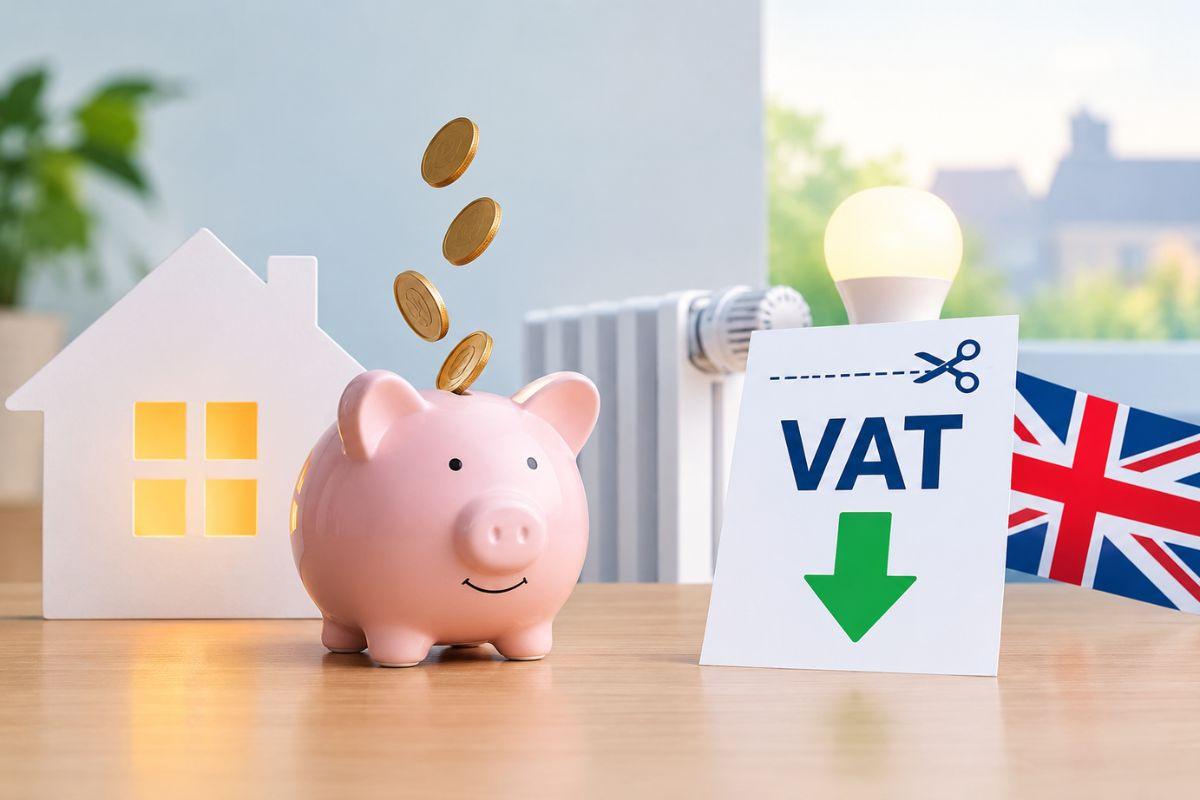
Quick Answer: Energy bills have been the sharpest worry in British homes this autumn. From 1 October 2026, VAT on domestic electricity falls from 5% to 0% in Great Britain. The UK household energy VAT cut is worth roughly £45 a year to a typical home, applies automatically, and runs for six months until 31 March 2027.
- VAT on household electricity drops from 5% to 0% on 1 October 2026.
- The relief lasts six months and ends on 31 March 2027.
- Average savings are about £45 a year, but your usage decides the figure.
- No need to apply — suppliers do it for you.
- Northern Ireland keeps the 5% rate because of post-Brexit rules.
- Ofgem’s price cap rises by £60 on the same day, so many bills still climb.
What the Cut Actually Changes
Suppliers add up your units used and your daily standing charge, then apply 5% VAT on top. That final step now disappears for homes in England, Wales and Scotland. Gas and other domestic fuels stay at 5%.
The policy paper on GOV UK confirms the mechanics. A new zero-rated group covers domestic electricity in Great Britain, while Northern Ireland stays in the reduced-rate rules. Around 100 electricity suppliers must switch their systems over and then switch back in April.
Prime Minister Andy Burnham announced the measure on 21 July 2026, the day after taking office. The Independent reported it as one of his first acts. The Treasury says it costs about £850 million in 2026/27, funded by scrapping the digital ID programme rather than raising other taxes. It also trims inflation by around 0.10 percentage points.
Also Read: UK Pension Withdrawal Rules Changing in 2027 and 2028: What Happens to Your Money?
How Much Will You Save?
The £45 headline is based on typical usage. Heavy users save more in cash terms because VAT tracks consumption.
| Your situation | What happens |
|---|---|
| Standard variable tariff | VAT removed automatically from 1 October |
| Fixed-rate tariff | Also zero-rated, even on a locked-in rate |
| Prepayment meter | No VAT is charged when you top up |
| Small firms and charities on 5% | The zero rate applies this winter too |
| Northern Ireland | Stays at 5%, funding sent to Stormont instead |
| Gas bills | Unchanged at 5% VAT |
Why Your Bill May Still Rise
Here is the sting. Ofgem’s price cap climbed 4% on the same morning, taking a typical dual-fuel direct debit bill to £1,723 a year. That is £60 more, or £5 a month. As The Sun pointed out, the rise outstrips the £45 saving by £15.
The regulator’s figures show gas driving it, up 8%, while electricity stayed broadly stable because VAT came off. Homes with no gas see a rise of under 1%. Roughly 22 million households sit on capped default tariffs.
So the cut did not lower bills. It stopped them climbing further.
The January Warning
Worse may be coming. Cornwall Insight’s latest forecast, shared with the BBC, puts the January 2027 cap at £1,999 — a jump of £276, or 16%. That would be the biggest rise in four years.
“These prices are going to hit households hard,” said Craig Lowrey, principal consultant at Cornwall Insight.
EDF has gone further, predicting around £2,098, some £375 above October’s level. Chief executive Simone Rossi warned: “We are actually walking into a second significant energy crisis after the one we experienced just four years ago.” He wants the VAT relief extended beyond April.
The driver is the US-Iran conflict. Disruption in the Strait of Hormuz has pushed up wholesale gas and oil prices and left European storage low. Ofgem sets the real January figure in late November.
Also Read: State Pension Tax Raid: Why UK Pensioners Are Closer to Paying Tax Than Ever in 2026
Who Gains Most From It
The Institute for Fiscal Studies makes an awkward point. Since the Iran war began, gas prices have risen 24% against 5% for electricity. Taking VAT off electricity alone, it argues, is not well aimed at the worst-hit homes.
That said, the poorest tenth of homes spend about 5% of their outgoings on electricity, against 2% for the richest tenth. Proportionally, the relief matters most at the bottom.
Fuel poverty charity National Energy Action notes it helps everyone but does less for low-income families heating with gas. The Guardian highlighted the winners: all-electric homes, heat pump owners and electric car drivers.
Which? energy editor Emily Seymour was measured: “Any cut to household electricity bills is positive news for consumers facing high energy costs.”
What Else Is On The Table
Ministers are reportedly weighing the same treatment for gas, worth perhaps another £40 a year. Any move would land in Chancellor John Healey’s Budget at the end of October.
Around 6 million homes also qualify for the Warm Home Discount, worth £150 off electricity bills this winter. A further £150 of costs was stripped from bills earlier in 2026.
Debt is the more profound problem. Energy UK puts household arrears at about £5.5 billion. A debt relief scheme has been consulted on but not launched. Thinktank Nesta wants November’s Budget used for longer-term reform, which it reckons could cut £130 from typical bills.
Also Read: Why HMRC Is Quietly Paying Back a Million Low-Paid Workers — And Most Won’t Even Notice
Frequently Asked Questions
When does the UK household energy VAT cut start and end?
Ans: It starts on 1 October 2026 and ends on 31 March 2027. That is six months of zero-rated electricity, covering the coldest and costliest part of the year.
Do I need to apply for the VAT cut?
Ans: No. Suppliers remove the 5% charge automatically. Nothing changes in how you pay, and you need not contact HMRC or your provider.
Does the cut apply to gas bills too?
Ans: Not at present. Gas stays at 5% VAT across the UK, though ministers are said to be considering extending the relief in the autumn Budget.
Will people in Northern Ireland benefit?
Ans: Not directly. Post-Brexit rules keep VAT at 5% there, but Stormont receives funding to deliver its cost of living support instead.
Why is my bill higher despite the VAT cut?
Ans: Because the price cap rose 4% on the same day, adding £60 a year. The £45 saving softens that increase rather than cancelling it out.
Will the VAT cut be extended past April 2027?
Ans: Nothing is confirmed. Suppliers and charities are pressing for an extension, and the Treasury has said it will keep reviewing support for families.
Sources & References