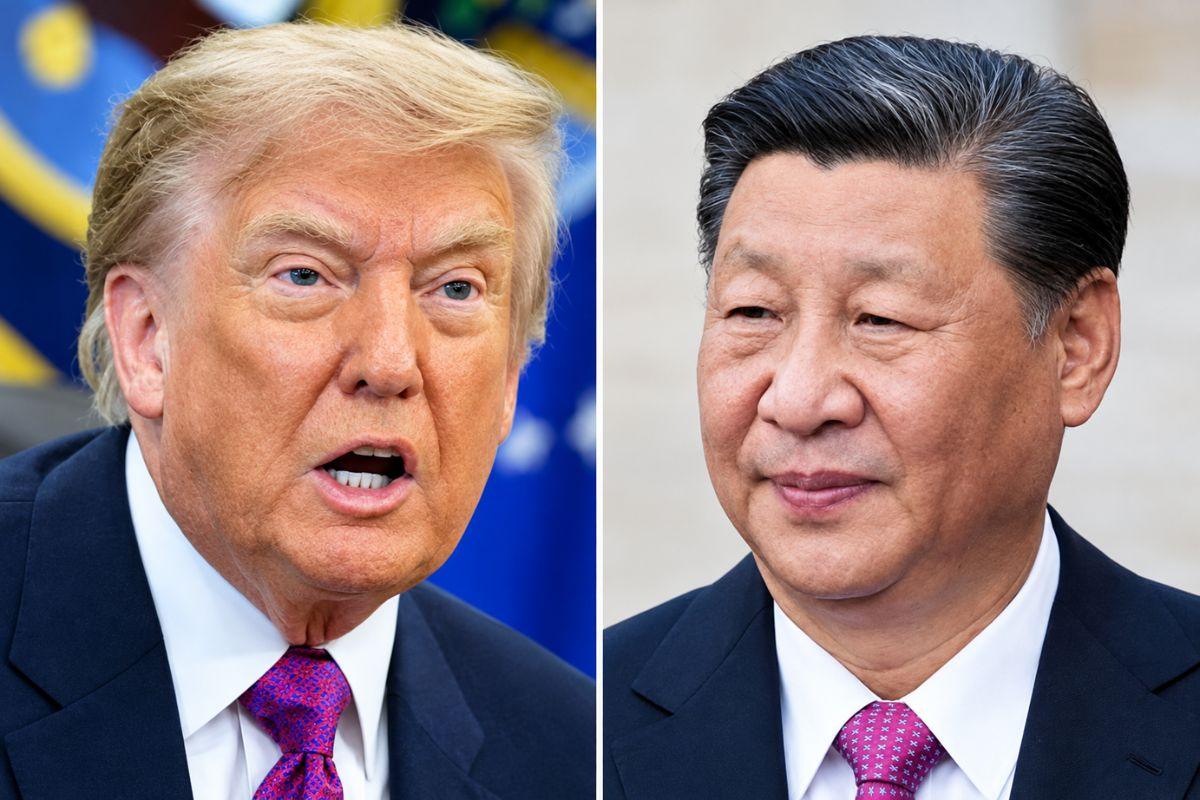
On Sunday, September 27, US Ambassador to China David Perdue said on “Fox News Sunday” that Trump asked Chinese President Xi Jinping if he wanted to buy weapons from the United States. Perdue said Trump raised it while defending the pending Taiwan arms sale. Perdue did not specify when the offer was made. His quoted words were: “He actually asked President Xi, would he like to buy some, at one point.”
The reporting frames this as a rhetorical device rather than a serious sales proposal. According to the Associated Press account, Trump justified the pending Taiwan sale to Xi by presenting it as one of many arms sales Washington makes around the world. The AP also noted that an actual sale would upend generations of US policy toward China and Taiwan and could expose US technology to a potential foe.
There is also a legal barrier. Mediaite reported that selling arms to China would violate US law, since China is under an arms embargo tightened after the 1989 Tiananmen Square Massacre. The offer, as described, was a negotiating remark and not a policy.
- The US ambassador to China says Trump asked Xi whether he would like to buy US weapons. The ambassador did not say when.
- The state visit produced an eight-point consensus, including a $30 billion reciprocal tariff-reduction arrangement and a new dialogue on AI.
- The US and Chinese accounts of the summit differ in several places.
- Taiwan arms sales remain the sharpest unresolved issue.
What The State Visit Produced
Xi’s three-day visit ended Friday, September 25. Reuters described it as showcasing personal diplomacy rather than big public breakthroughs. Still, several concrete items emerged.
Tariffs. According to the White House, the two countries reached consensus on recommendations for more favorable tariff treatment for $30 billion of non-sensitive goods in each direction. Japan Times reporting on the published lists said the US-bound list has 77 entries, including fireworks, household products, sporting equipment and toys, while 1,619 goods could enter China, such as meat, seafood, dairy, grains, coal, timber and medical equipment.
Coal. The White House says China will import at least 10 million metric tons of US coal in 2027 and again in 2028.
Boards and truce. The leaders put into operation the US-China Board of Trade and Board of Investment, chartered during the May 2026 summit in Beijing. Separately, Treasury Secretary Scott Bessent said the two sides extended a trade truce due to expire November 10 by two months, to allow more time for a bigger deal.
AI. The White House says the leaders established a US-China Super Intelligence Dialogue, with the next exchange by November 2026, and a bilateral channel for incidents. The two sides also agreed on the wording: “super intelligence” in place of “artificial intelligence.”
Iran and shipping. The White House says the leaders agreed Iran can never have a nuclear weapon and that no country can impose tolls on international waterways. Perdue called the Iran-related points three “huge” takeaways, citing an open Strait of Hormuz, no tolls and no Iranian nuclear weapon.
Drugs. The fact sheet says China arrested 21 Chinese citizens in August 2026 for manufacturing and distributing precursor chemicals for illicit drug producers in North America.
Also Read: How Pension Recycling Rules Affect Your Retirement Savings
Two Governments, Two Versions
The two sides did not describe the summit identically. Beijing’s Foreign Ministry said it agreed with Washington on a $30 billion reciprocal tariff-reduction arrangement, an AI dialogue and a trade council. The White House used the softer word “recommendations” for the tariff treatment, which suggests the cuts still need to be put into effect.
The Hill reported that the agreement’s final part was to strengthen military crisis communications, with a memorandum of understanding to prevent confrontations between armed forces. The White House fact sheet I could read does not mention this. Rare earths are also handled differently: the White House says the two sides continue to work on supply chain shortages related to rare earths and other critical minerals.
For readers, the safest reading is that the outline is agreed, but the legal and customs details are not yet visible at the border.
Why Taiwan Is The Pressure Point
The arms remark lands on a live dispute. The AP reports that after the May summit in Beijing, the United States paused the sale of a record-breaking $14 billion package. It adds that Trump described arms sales to Taiwan as a “very good negotiating chip” with China.
This has drawn attention in Washington. Host Shannon Bream raised Republican and Democratic concerns about delayed aid packages and weapons orders to Taiwan. Perdue pushed back, saying Trump is as strong on Taiwan as anyone he has seen, and claimed Trump has sold 50% more arms to Taiwan than any other president since 1979. That is Perdue’s claim, and I could not independently verify it.
Legally, the US is bound by its own laws to provide Taiwan with the means to defend itself. Perdue also said the two leaders continue to discuss future sales, which is notable. Earlier reporting noted that previous administrations, including Trump’s, had refused to consult Beijing before arms sales to Taiwan.
Also Read: HMRC Apologises for Nine-Year State Pension Forecast Error Affecting Thousands
What To Watch Next
- The paused $14 billion Taiwan package. Whether it moves forward will show if arms sales are policy or leverage.
- The trade truce. It runs on a short extension, so a larger deal is still unfinished.
- The November AI dialogue. It is the next scheduled exchange.
- APEC and G20. Each leader intends to attend the other’s summit as host.
Frequently Asked Questions
Did Trump offer to sell weapons to China?
According to Ambassador Perdue, Trump asked Xi if he would like to buy some US arms. Reporting describes it as part of Trump’s argument that Taiwan sales are ordinary, not a formal offer. No sale has been announced.
Is it legal to sell arms to China?
Mediaite reports that it would violate US law because of the embargo tightened after 1989.
What was agreed at the Trump-Xi summit?
An eight-point consensus that includes the $30 billion tariff arrangement, a trade council, an AI dialogue, coal purchases, and shared positions on Iran.
Have tariffs actually been cut?
Not yet, based on the White House wording of “recommendations.”
Sources & References
- The White House, “Fact Sheet: President Donald J. Trump Advances a Fair and Reciprocal Relationship with China
- Associated Press, “Trump asked China’s president if he wants to buy US arms, ambassador says”
- Reuters, “China, US agree to $30 billion tariff cut, AI dialogue during Xi visit, Beijing says”
- The Japan Times, “U.S. and China release product lists for $30 billion tariff deal”