Halloween didn’t come from one place. It grew out of two traditions that overlapped for centuries: the Gaelic festival of Samhain, and the Christian season of All Hallows’ Eve, All Saints’ Day and All Souls’ Day. The costumes, trick-or-treating and jack-o’-lanterns arrived later, carried along by medieval folk customs, Irish and Scottish emigrants, and twentieth-century America. And the dark parts? They’re not really about witches or sacrifice. They’re about prayers for souls stuck in purgatory, nights of wrecked property, and a panic over poisoned candy that never matched the facts.
- Two roots, no inventor: Halloween grew from Gaelic Samhain and the Christian All Hallows’ season, which blended over centuries.
- The “2,000 years” claim is tradition: Our earliest written evidence for Samhain comes from early medieval Irish texts.
- The dark side is mostly human: Souling prayers for purgatory, the 1933 “Black Halloween” vandalism and a candy panic, not witches or sacrifice.
- Stranger-poisoned candy is a myth: Joel Best found no documented case, and the 1974 O’Bryan death was a murder by the boy’s own father.
- 2026 is a record year: The NRF projects $13.5 billion in US spending, up from $13.1 billion in 2025.
What Is Samhain, and Is It Really 2,000 Years Old?
Samhain was a Gaelic festival that marked the end of the harvest and the turn toward winter, the darker half of the year. It fell around 31 October and 1 November. People believed the line between the living and the dead went thin that night. Bonfires, feasts and food left out for the dead were all part of it.
You’ll see “2,000 years old” attached to Samhain almost everywhere. Take it as tradition, not proof. The clearest written evidence we have comes from early medieval Irish texts, written long after the ancient Celts. How the festival was actually practiced in the distant past is something nobody can say with confidence.
Also Read: British Icons: The Symbols That Still Represent Britain
Where The Name Comes From
The word itself is Christian. “Hallow” is an old word for a saint, and All Saints’ Day was once called All Hallows. The evening before it was All Hallows’ Eve, and over the centuries that got worn down to Hallowe’en, then Halloween.
Britannica notes that the first evidence for 1 November as the feast date comes from the time of Pope Gregory III (731–741), who dedicated a chapel in St. Peter’s in Rome to all the saints. Pope Gregory IV ordered the feast observed generally in 837. Go back more than a century before Gregory III and you reach 609, when Boniface IV dedicated the Pantheon to Mary and the martyrs, a feast traditionally kept on 13 May. All Souls’ Day came later, on 2 November. Abbot Odilo of Cluny added it to his monasteries’ calendar in 998.
Did The Church Invent Halloween to Erase Samhain?
It’s probably the most repeated claim about Halloween, and it’s also one of the most argued over. Plenty of writers assume the Church chose 1 November to bury a pagan festival. Historian Kyle Smith disagrees. He says the pope’s move just made official what many parts of Europe were already doing for All Saints’ Day, with Samhain not the target.
Most careful accounts settle somewhere in between. Two calendars of the dead ran side by side for centuries, and each borrowed from the other. No single pope or druid invented Halloween.
The Genuinely Dark Part: Souls, Prayers and Purgatory
The medieval layer is the eeriest of all. Around All Hallows, poor people, often children, went door to door in England and Ireland and offered prayers for a household’s dead relatives. They were paid in small spiced “soul cakes.” Because people believed in purgatory, those prayers carried real weight. The living thought they could shorten the suffering of the dead.
Guising is the other ancestor of trick-or-treating. In Scotland and Ireland, costumed children would perform a song or a joke and get a treat for it.
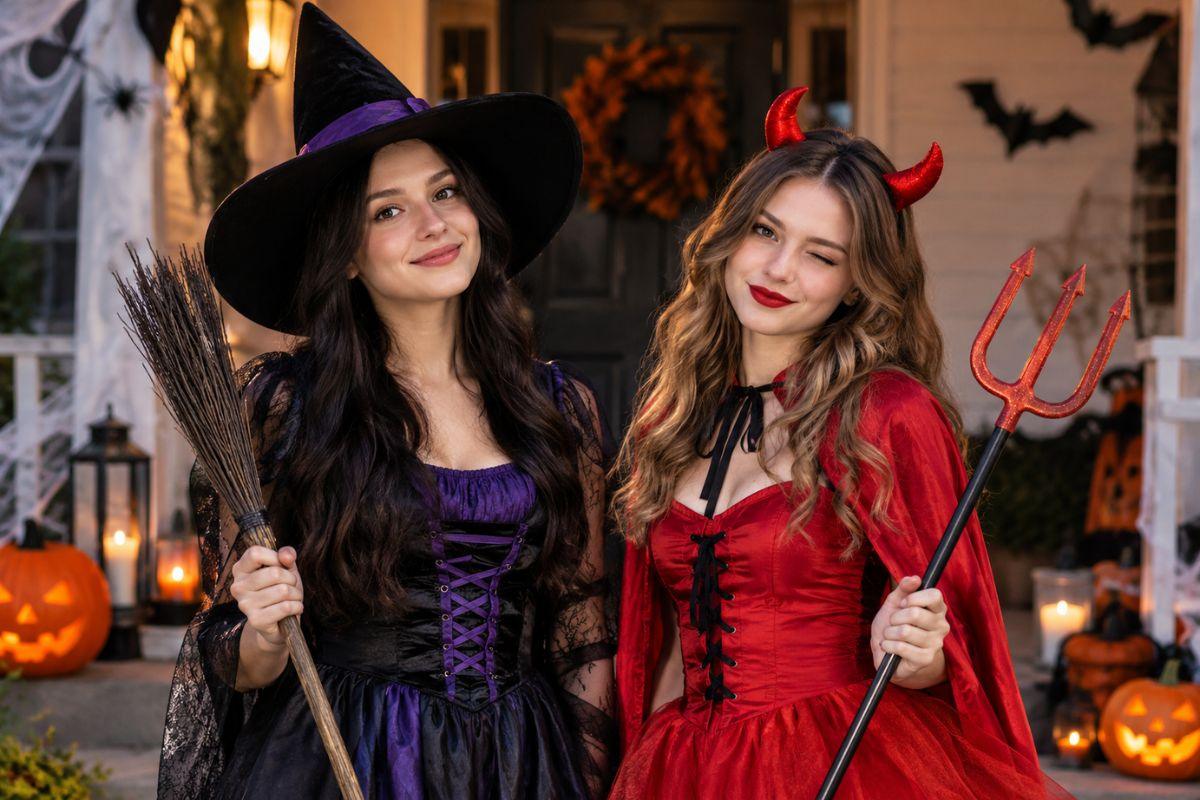
Costumes are a debate of their own. Some popular accounts give the credit to the ancient Celts. Halloween author Lisa Morton says there’s no evidence for that, and she calls the idea very modern. She notes that costumes may instead trace back to older Christmas customs, where costumed performers visited homes.
From Ireland to America
Early America didn’t make much of Halloween. That changed with mass Irish immigration in the nineteenth century, especially after the Famine years of the mid-1840s into the early 1850s, which helped bring the customs across the Atlantic. The turnip lanterns linked to the legend of Stingy Jack gave way to pumpkins. The reason was practical: pumpkins were everywhere, and they were far easier to carve.
Also Read: What Makes British Values So Important in Modern Britain?
Black Halloween: When Pranks Turned Destructive
In the early twentieth century, Halloween was often about mischief rather than candy. By the 1930s the mischief had turned serious. Morton describes vandals smashing lights, starting fires and tripping people on sidewalks. In 1933 the destruction was bad enough that the night picked up the nickname “Black Halloween.”
Civic leaders answered with organised, supervised trick-or-treating, hoping to give kids something better to do. Sugar rationing paused the custom during the Second World War. Once the war ended, the new suburbs turned it into a mass habit.
The Poisoned Candy Panic
The fear of tainted treats is the darkest modern chapter, and it’s mostly myth. Joel Best, a sociologist at the University of Delaware, has studied what he calls “Halloween sadism” since the 1980s. He has found no evidence that a child was killed or seriously harmed by treats handed out by strangers.
The one famous exception actually backs him up. In 1974, eight-year-old Timothy O’Bryan died in the Houston area after eating cyanide-laced candy. His father, Ronald Clark O’Bryan, had taken out life insurance on his children just days before. He was convicted and executed in 1984. The killer was a parent, not a stranger at the door. Best can’t prove a negative, but no stranger-poisoning has ever been documented.
Halloween in 2026: The Latest News
Spending hits a new high. The National Retail Federation projects that Americans will spend $13.5 billion this year, up from last year’s record of $13.1 billion. That works out to $115.14 per person. About 74% of consumers plan to celebrate. Costumes lead the categories at $4.4 billion, with decorations at $4.3 billion and candy at $4.1 billion. Pet costumes alone account for roughly $920 million. The same survey found that 47% of shoppers use AI tools to plan their Halloween, and 79% expect tariffs to push prices up. Keep in mind these are surveyed spending plans, not final sales.
Ireland leans into Samhain. Derry Halloween turns 40 this year. It runs alongside the Púca Festival in Trim and Athboy, County Meath, which brings fire performances, storytelling and heritage tours. Derry’s organisers say their festival draws more than 100,000 people a year.
Not every city wants the crowds. In Tokyo, Shibuya’s Halloween street parties are now banned, though people still celebrate in other parts of Japan.
Not Everyone Marks It the Same Way
Mexico’s Día de Muertos, held on 1 and 2 November, is its own tradition with Indigenous and Catholic roots. It isn’t “Mexican Halloween.” In Germany, 31 October is Reformation Day, which remembers Martin Luther and 1517. In Hungary, families visit cemeteries and light candles on Halottak napja.
Also Read: Thoughtful DIY Secret Santa Gift Ideas for Office Colleagues
Frequently Asked Questions
Where did Halloween originate?
It comes from a blend of the Gaelic festival Samhain and the Christian feasts of All Saints (1 November) and All Souls (2 November), mixed together over many centuries.
Why is Halloween on October 31?
It’s the eve of All Saints’ Day. Samhain also fell at around the same time of year.
Did the Catholic Church create Halloween to replace Samhain?
Historians don’t agree. The evidence points more toward overlap and mutual influence than a deliberate replacement.
Where does trick-or-treating come from?
Mostly from medieval souling and from Scottish and Irish guising. It took its modern form in America between the 1930s and 1950s.
Is poisoned Halloween candy a real danger?
Research hasn’t found a documented case of a stranger fatally poisoning trick-or-treaters. The best-known death, in 1974, was a murder committed by the child’s father.
Why did jack-o’-lanterns switch from turnips to pumpkins?
Irish immigrants in America found pumpkins plentiful and much easier to carve.
Sources & References
- Britannica, All Saints’ Day(Gregory III and Gregory IV dates)
- NRF Halloween spending survey 2026 (via Chain Store Age, $13.5B projection)
- Smithsonian Magazine, “Where Did the Fear of Poisoned Halloween Candy Come From?”
- TODAY, “History of Halloween” (Lisa Morton on costumes and the 1933 “Black Halloween”)
- University of California Press blog, “The Deep History Lurking Behind Halloween”