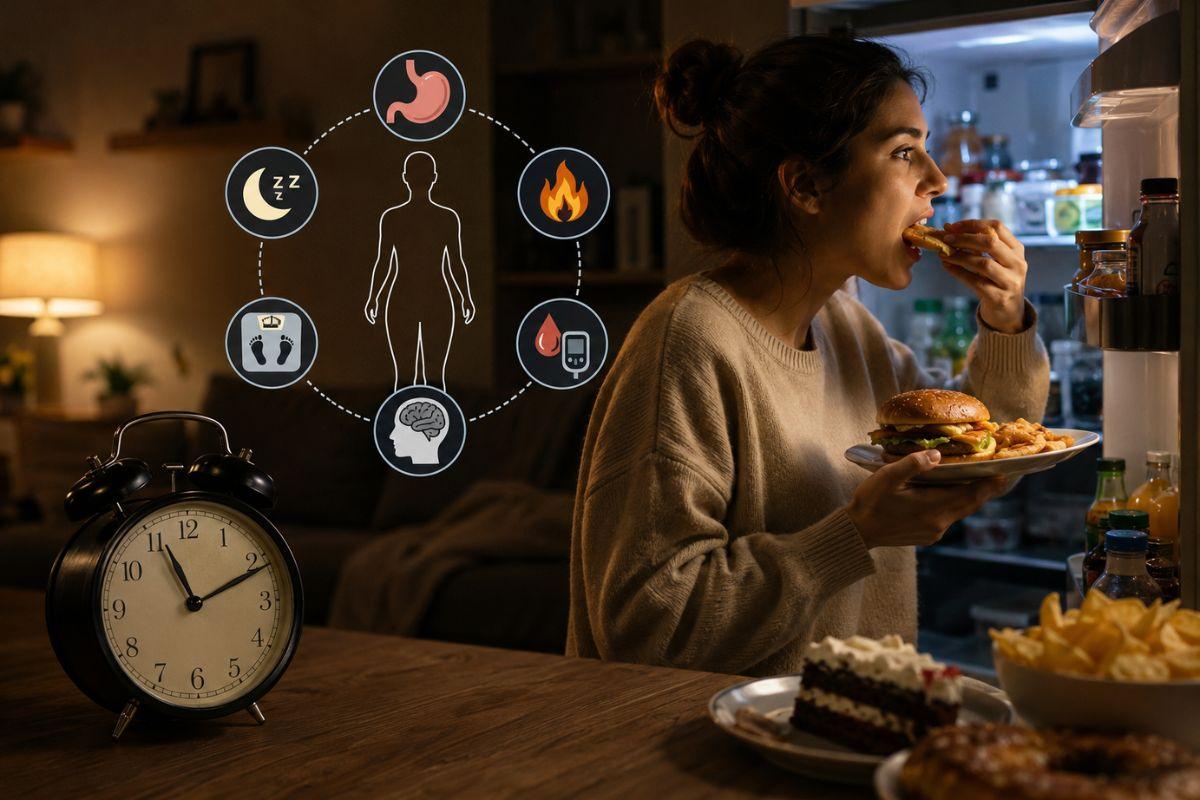
Eating late doesn’t flip some switch that turns food into fat. But it’s not completely harmless either. Controlled studies have found real changes in metabolism, hunger, and blood sugar when people eat later, even when everything else — calories, sleep, activity — is kept the same. And in real life, late eating usually comes bundled with extra snacking and bad sleep, which is honestly where most of the actual weight gain comes from.
You’ve probably heard it a hundred times — don’t eat after 8pm, your body just stores it as fat overnight. It’s one of those diet rules everyone repeats but almost nobody checks. So I went and looked at what the actual research says, not gym forums or Instagram captions.
- There’s no magic cutoff hour. No study has ever pinned down a specific time after which food “becomes” fat.
- In a 2022 Brigham and Women’s Hospital trial, shifting meals about four hours later lowered how many calories people burned and increased their hunger — even with calories and sleep controlled.
- People following the same calorie-controlled diet in a University of Murcia study lost weight more slowly if they ate later in the day.
- Blood sugar after meals was measurably higher when the same dinner was eaten at 10pm instead of 6pm, in a small comparison study.
- On average, people who stay up late end up eating around 500 extra calories a day, mostly from late-night snacking.
- Big meals close to bedtime can mess with sleep, and poor sleep raises ghrelin (hunger hormone) while lowering leptin (fullness hormone) — so you’re hungrier the next day regardless of what you ate at night.
- Late snacks tend to be junk food, not because people plan it that way, but because willpower is lower late at night.
What actually happens when you eat late

There’s a well-known 2022 study out of Brigham and Women’s Hospital, published in Cell Metabolism, that’s probably the best evidence we have on this. Researchers wanted to isolate timing from everything else — so they controlled food intake, sleep, and activity, and just shifted when people ate. One group ate on a normal schedule, the other about four hours later.
The later group got hungrier, burned fewer calories, and showed changes in fat tissue that push toward more fat storage. That’s a big deal because it means timing alone did something, not just “people who eat late also eat worse” (which is also true, separately).
A smaller trial did something simpler — same exact dinner, eaten either at 6 pm or 10 pm, same bedtime for everyone. The people who ate at 6 had lower blood sugar afterwards than the 10 pm group. That matters because repeated blood sugar spikes over time are tied to fat storage and insulin resistance.
Then there’s older research from the University of Murcia in Spain, which followed dieters who were all eating the exact same number of calories. The ones eating their main meal later in the day lost weight slower than the early eaters. Same diet, same calories — different result, just based on timing.
Why late eating causes weight gain in the real world
Here’s the thing though — most people aren’t running a controlled trial in their kitchen. Late-night eating in real life usually means extra food on top of what you already ate that day. Research shows people who stay up later eat roughly 500 more calories on average, and most of that shows up right before bed.
It’s also rarely a balanced snack. It’s chips, ice cream, leftover pizza — stuff that’s easy to overeat without really noticing, partly because you’re tired and your brain isn’t exactly making its best decisions at 11pm.
Also read: Pillow for Neck Pain: How to Pick One That Actually Helps
The sleep piece nobody talks about enough
A heavy meal close to bedtime raises your body temperature and keeps your digestive system working right when it should be winding down. That can delay sleep or make it worse quality.
And bad sleep doesn’t just make you tired — it directly messes with appetite hormones. Ghrelin (which makes you hungry) goes up, leptin (which tells you you’re full) goes down. So the next day you’re hungrier than you’d normally be, and that has nothing to do with what you ate the night before — it’s a knock-on effect from the sleep loss itself.
So is it a myth or not
Depends what exact claim you’re testing.
“Any food eaten late automatically becomes fat” — not true, no evidence for that.
“Timing makes zero difference as long as calories match” — also not quite true, based on the studies above.
“Late-night eating patterns are linked to more weight gain in real life” — yeah, this one holds up, mostly because of what people eat late and how it wrecks their sleep.
What to actually do about it
If you’re trying to manage your weight, shifting more calories earlier in the day seems to genuinely help, based on the glucose and metabolism research. If you do eat late sometimes, keep it light and skip the ultra-processed stuff. And honestly, protecting your sleep might matter just as much as the meal timing itself.
One late dinner isn’t going to ruin anything. This is about patterns repeated over weeks and months, not a single meal.
FAQ
Q. Does eating after a certain time turn food straight into fat?
A. No. There’s no biological cutoff where this happens. What changes later in the day is how efficiently your body handles insulin and burns calories — not some fat-conversion switch.
Q. Does eating late slow down your metabolism?
A. It can, at least short-term. The Brigham and Women’s Hospital study found people burned fewer calories when eating on a delayed schedule, even with intake kept identical.
Q. Is late-night snacking worse than just eating dinner late?
A. Usually yes, because snacking tends to be extra calories on top of a full day of eating, and it’s often less healthy food than a planned meal would be.
Q. Can you eat late and still lose weight?
A. Yes — if your total calories, food choices, sleep, and activity are all in check. Timing is one piece of the puzzle, not the whole thing.
Q. Does eating late affect sleep, and does that affect weight?
A. It can. Heavy meals close to bedtime can delay or worsen sleep, and poor sleep raises hunger hormones the next day, which often leads to overeating.
Q. Is there a better rule than “don’t eat after X pm”?
A. Try to eat your biggest meal a few hours before bed, keep anything late light, and don’t neglect sleep — it plays just as big a role as the clock does.
Sources
- Study looks at why late-night eating increases obesity risk — Harvard Gazette / Harvard Medical School
- Research suggests eating later may lower metabolism — UCLA Health
- Does eating close to bedtime make you gain weight? It depends. — National Geographic
- Will eating before bed cause weight gain? Understanding the facts — Archwell Health
- Does eating late at night cause weight gain? — Form Health
- University of Murcia meal-timing and weight-loss research, summarized — HealthifyMe
Disclaimer: This is general information, not medical advice. Talk to a doctor or dietitian for anything specific to your health.