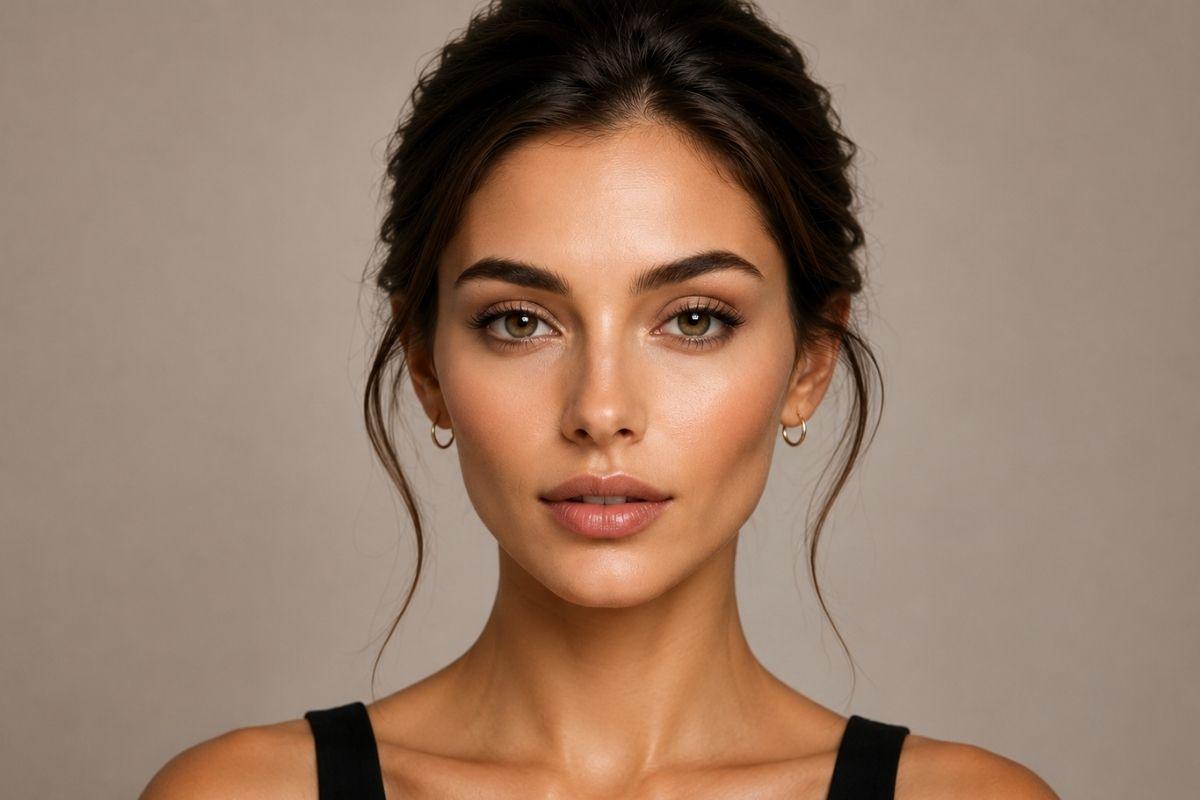
Nobody sat down one day and decided high cheekbones were attractive. It just kept coming up, in every decade, every culture, every beauty conversation, without anyone really explaining why. Angelina Jolie has them. So does Lupita Nyong’o, Cate Blanchett, and pretty much every face that’s ever stopped a room. The zygomatic bones, those prominent arches just below the outer corners of the eyes, show up so consistently in faces we call beautiful that researchers eventually had to ask whether this was fashion or something older and more hardwired. Turns out it’s the second one, mostly, and the reasons are more interesting than most beauty writing bothers to explain.
- Cheekbones are basically your zygomatic bones, sitting just under the outer corner of each eye. High ones jut out noticeably.
- They get sharper as you hit adulthood, mostly because baby fat melts away and the bone underneath finally gets to show off.
- For women, it’s oestrogen doing the work during development. For men, testosterone. Either way, it’s your hormones leaving a mark on your face.
- There’s a 1998 Perrett study backing this up too, and the attractiveness link showed up across very different cultures. Not just a Western thing.
- NYU also found something interesting: high cheekbones don’t just look good; they make people seem more trustworthy. Two separate traits, one feature.
- And here’s the practical bit. That bone acts like scaffolding for the skin above it, so high cheekbones tend to age more slowly in the midface.
Why Naturally High Cheekbones Are Considered Attractive: Top Benefits
There are two of them, one on each side, tucked just below the outer eye corner and running toward the ear. That’s the zygomatic bone doing its thing. High and forward-projecting? That’s what gets called high cheekbones. Flatter and lower, and you get a rounder, softer look instead. Not a better-or-worse situation. Just two different faces. What’s interesting is the brain doesn’t treat them the same way, and researchers have actually dug into why.
Genetics mostly determine yours. Ethnicity, general bone structure, and how the rest of your facial skeleton sits all contribute. The position is fixed. What the cosmetics industry built around simulating it, primarily contouring, tells you more than anything else about how consistently this feature has been associated with attractive faces across generations.
Why the Science Behind High Cheekbones Is Worth Understanding?
Here’s where it stops being just about beauty standards and gets genuinely interesting. Multiple studies in evolutionary psychology found that prominent cheekbones are rated as attractive across completely different cultures and populations. Standardised facial rating studies, run across diverse groups, keep landing on the same result. This cross-cultural consistency is what pushed researchers to look for an explanation deeper than fashion.
The answer they kept finding was about what the bones signal. In women, cheekbone prominence during development tracks directly with oestrogen levels. A face with well-defined, prominent high cheekbones is, below the level of conscious thought, being read by the brain as a face shaped by healthy hormonal development. Perrett et al. confirmed this in 1998 across diverse populations, not just Western samples, which is the detail that matters most in that study.
In men, the picture shifts slightly. Cheekbone prominence combined with wider facial breadth tracks testosterone-driven development during puberty. This is the mechanism behind what got called the Neville Longbottom effect online, that sometimes dramatic shift from round-faced teenager to sharp-featured adult that’s so often driven by cheekbone development. Male faces scoring high on cheekbone prominence tend to be perceived as dominant and masculine. Different signals to the female case, but equally consistent in the data.
Also Read: The Hidden Symptoms Everyone Misses: 5 Weird Signs of Iron Deficiency
The Age Connection Nobody Talks About Enough
Cheekbone prominence becomes most noticeable as you enter adulthood. After that, it gradually decreases as bone density shifts and facial fat redistributes. What this means practically is that a face with prominent high cheekbones is being read, below conscious thought, as a young face. The heart-shaped configuration, wide cheekbones above, narrower jaw below, reads as youthful because developmentally it is. The same face years later, as the fat pads redistribute downward and the structural landscape changes, stops reading the same way.
There’s a mechanical advantage here too. The zygomatic bone provides structural support to the skin sitting above it across the midface. Faces with more prominent cheekbones tend to show ageing more slowly in that zone because there’s more bone underneath holding things up. This is not a trivial point. It’s the same logic that explains why cheek filler and fat transfer procedures are among the most commonly requested treatments in aesthetic medicine right now. People are essentially paying to recreate the structural support that high cheekbones provide naturally.
The Trustworthiness Finding
This one catches people off guard. Research out of New York University (NYU) found that faces with high cheekbones were consistently rated as more trustworthy by participants, not just more attractive. The study ran twice with the same participants to rule out random variation, and the brain reached identical conclusions both times. High cheekbones in the social assessment the brain runs on every face it encounters seem to signal reliability, not just attractiveness.
Whether that perception has any basis in actual personality or character, the research doesn’t claim to know. What it establishes is that the association is real, consistent, and operates below conscious decision-making. People aren’t choosing to trust cheekbone-prominent faces more. It’s happening before that choice gets made.
What the Beauty Industry Figured Out Long Before the Research Did?
Contouring has been mainstream since at least the early 1980s. Shadow placed below the cheekbone, highlight placed on top of it, the whole technique exists to simulate what prominent high cheekbones create naturally. It’s been in professional makeup training for decades. The fact that it became a mainstream consumer skill in the social media era doesn’t change how long the underlying logic had already been understood by working makeup artists.
That’s not a coincidence. It’s practical knowledge, accumulated over decades of watching what the eye responds to in a face, eventually formalised into a teachable method. The research caught up to what professional makeup artists already knew. High cheekbones change how a face reads. The question researchers eventually answered was why.
Also Read: Men’s Skincare Routine for Beginners: A No-Nonsense Guide
The Honest Caveat
None of this means faces without prominent high cheekbones are less attractive. Facial attractiveness research is consistent on this point. Individual features rarely determine overall ratings on their own. Symmetry, skin quality, facial harmony, the way features work together as a complete system, all carry genuine weight in how attractive a face is rated. High cheekbones contribute something documented and meaningful to that equation. Youth signal, hormonal health signal, structural ageing advantage, trustworthiness perception. But they’re one variable in something considerably more complex than any single feature can account for on its own.
FAQ
What are high cheekbones?
The zygomatic bones sit prominently just below the outer corners of the eyes. When they project noticeably forward and sit high on the face, they create the angular, sculpted look associated with the term.
Why are high cheekbones considered attractive?
Research links them to signals of youth, hormonal health, and developmental maturity. In women, they track oestrogen levels during development; in men, testosterone-driven development. The association holds across cultures.
Do high cheekbones slow facial ageing?
To a measurable degree, yes. The bone provides structural support to the overlying midface skin, which tends to slow visible ageing in that area compared to a flatter bone structure underneath.
Are high cheekbones attractive in both men and women?
Yes, though the signals differ. In women, they’re associated with femininity and hormonal health. In men with dominant, testosterone-influenced development. Both associations are positive and cross-cultural.
Can you fake high cheekbones without surgery?
Contouring makeup uses shadow below and highlight on the bone to simulate the effect. Clinical options include cheek filler and fat transfer for a more lasting result.
Sources and References
- Smile Tracker – High Cheekbones Science and Attractiveness Research
- Bustle – Why Are High Cheekbones Considered Attractive
- Royal Dental Clinics – Are High Cheekbones Attractive on Women
- The Beauty Foodie – Are High Cheekbones Attractive
- Dallas Single Mom – Physical Features Scientists Say Make You More Attractive
- Medium – High Cheekbones: The Science and Style Behind That Coveted Look