It’s a draw, with a slight edge to cyclic sighing if you’re thinking long-term.
The most cited trial found that cyclic sighing lifted daily mood the most and lowered breathing rate the most across a month. A newer 2026 pilot found that one minute of either technique eased anxiety in the moment. Box breathing picked up a small bonus on one attention test. So: need to settle down right now? Use whichever you like. Building a daily habit? The evidence leans toward cyclic sighing.
- Neither technique has been proven better for anxiety: in the 2023 Stanford trial, cyclic sighing and box breathing cut state anxiety by about the same amount.
- Cyclic sighing had the strongest daily mood boost and the biggest drop in breathing rate over 28 days, but only compared with mindfulness meditation.
- A 2026 pilot found one minute of either technique eased anxiety in the moment, with box breathing showing fewer inhibition errors on one attention test.
- Both exercises slowed reaction times in the 2026 study, so a breathing break may not help before tasks that need quick reflexes.
- Two registered trials (NCT06526585 and NCT07621042) will compare the techniques head to head, so a firm answer is still pending.
How This Argument Got Started
Back in January 2023, a Stanford-led team published a randomized trial in Cell Reports Medicine. Over 28 days, people did five minutes of daily breathwork or five minutes of mindfulness meditation. Three breathing styles were tested: cyclic sighing, box breathing, and cyclic hyperventilation with retention. Everyone practiced at home, wore a WHOOP strap, and scored their mood and anxiety before and after each session.
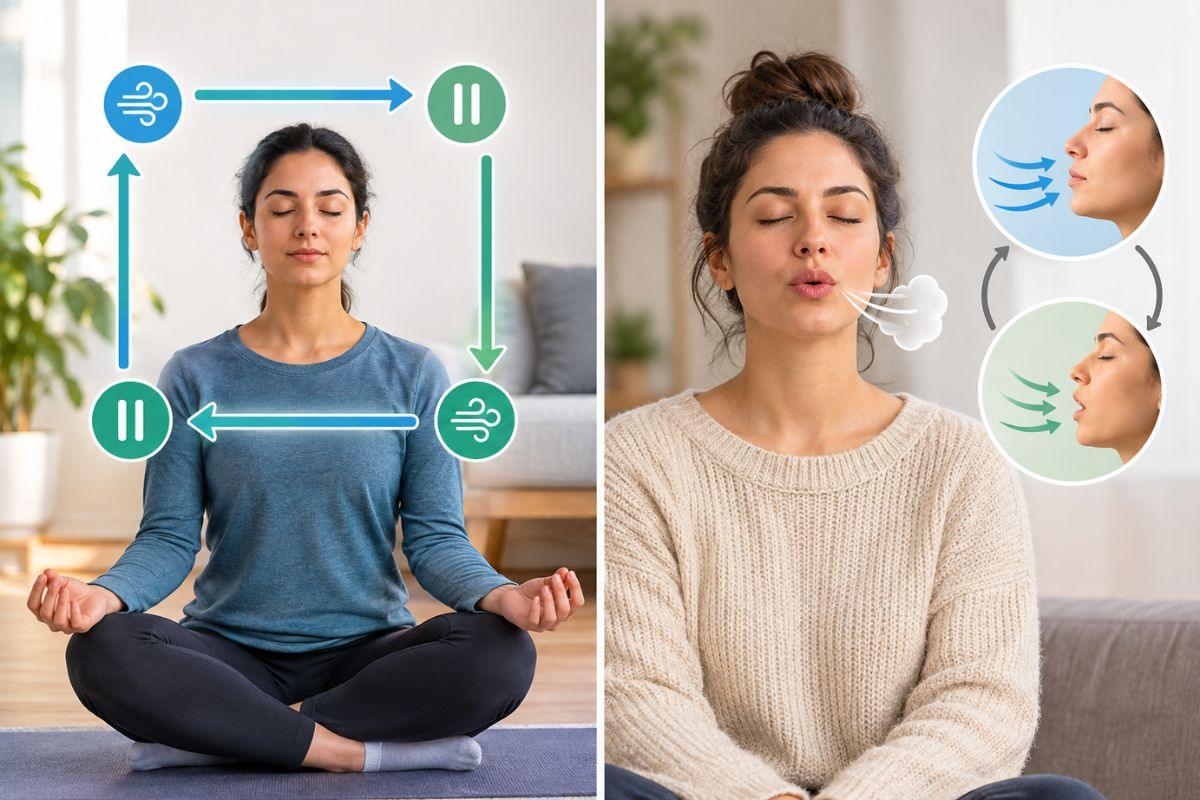
The three styles feel quite different. In box breathing, the inhale, hold, exhale and second hold all last the same time. Cyclic sighing leans on a long exhale and starts with a double inhale: a full breath, then a smaller top-up sip of air. The hyperventilation style flips things around, with longer inhales and shorter exhales.
Also Read: How Eye Patches Can Give Your Under-Eye Area a Quick Refresh
What The 2023 Trial Really Showed
You’ve probably seen the headline “breathing beats meditation.” It’s half right.
On anxiety, nobody beat anybody. Every group, mindfulness included, felt less anxious right after practice. Average drops: about 3.85 points for cyclic sighing, 3.75 for box breathing, and 3.95 for mindfulness. Yes, mindfulness had the biggest number. The statistics showed no real difference between breathwork and meditation here.
On mood, breathwork did win. Daily positive feelings rose more with breathwork, and cyclic sighing was the only single technique to clearly beat mindfulness. Box breathing also scored higher than mindfulness, but not by enough to count.
On body measures, cyclic sighing was tied to a bigger decline in respiratory rate than mindfulness. Heart rate variability, resting heart rate and sleep didn’t budge in any group.
Now the caveats, because there are plenty. The study enrolled 108 people, with just 30 in the cyclic sighing group and 21 in box breathing. The authors themselves said that’s too few to compare the individual techniques with confidence. Some news stories say 114 participants, but that was the invited number. People practiced at home, so nobody could check how well they followed instructions. And the trial was registered after the fact, which the authors described as exploratory.
Then 2026 Added a Twist
In April 2026, a German group (Riedl and colleagues, working from the Catholic University of Eichstätt-Ingolstadt) published a pilot study in Anxiety, Stress, & Coping. It tested something more everyday: what happens when you do a very short exercise during a stressful moment?
Forty-seven people filled out a quick anxiety questionnaire while under real-life stress. They were then given one minute of box breathing, one minute of cyclic sighing, or no exercise at all. Five minutes later, they were tested again on anxiety and attention.
Both breathing styles beat the no-exercise group on anxiety. Box breathing also led to fewer inhibition errors, meaning fewer slips in holding back a wrong response, and this showed up most in people with high trait anxiety. Here’s the odd part: reaction times got slower after both exercises.
Please don’t read this as “box breathing is better.” The study didn’t claim that. It’s a small pilot that only looked at the first few minutes afterward. The slower reactions do hint at something practical, though: if you’re about to do something that needs fast reflexes, a breathing break may not help.
Also Read: Pillow for Neck Pain: How to Pick One That Actually Helps
Side by side
| Feature | Box Breathing | Cyclic Sighing |
|---|---|---|
| Pattern | Inhale, hold, exhale, hold, all equal | Double inhale through the nose, long exhale |
| Best Evidence | Quick anxiety relief; fewer inhibition errors (2026 pilot) | Better daily mood and lower respiratory rate over a month (2023) |
| Breath Holds | Yes | None |
| Learning Curve | Moderate; you count | Low |
How to do them
Cyclic sighing, the Stanford way:
- Sit or lie down and set a timer for five minutes.
- Breathe in slowly. Once your lungs feel full, sip in a second, shorter breath on top.
- Let it all out in a long, slow exhale.
- Keep going until the timer ends. The researchers preferred inhaling through the nose and exhaling through the mouth, but nose-only was allowed.
Box breathing, the Stanford way: Breathe in, hold, breathe out, hold, each for the same number of seconds. Four is the usual choice. The study personalized the count: people timed one slow, full exhale. Under 20 seconds meant 3–4 seconds per side. Between 25 and 45 meant 5–6. From 50 to 75 meant 8–10. If it ever feels like a strain, make the count shorter.
So which one is for you?
Need relief within a minute? Either one. Choose whichever feels more natural.
Don’t like holding your breath? Cyclic sighing never asks you to.
Want a daily practice to lift your mood? Cyclic sighing has the stronger case, though keep in mind that comes from one small trial, compared against mindfulness only.
Like having something to count? Box breathing gives your mind a job.
One safety note. The Stanford trial excluded people with heart disease, a history of seizures, pregnancy, and certain other medical or psychiatric conditions. If any of those apply, check with a clinician first. And breathing exercises aren’t a substitute for treating an anxiety disorder.
What Could Settle It
Two registered trials are set up to compare these techniques head to head. Stanford’s (NCT06526585) pits cyclic sighing and box breathing against hypnosis and an audiobook, with MRI scans before and after 28 days of daily practice, and plans to enroll 80 people. A Spanish-language trial (NCT07621042) has four arms: box breathing, cyclic sighing, and a hybrid of cyclic sighing with mindfulness cues, with heart rate variability included.
Until their results come out, “which is better?” doesn’t have a firm answer.
Also Read: The Hidden Symptoms Everyone Misses: 5 Weird Signs of Iron Deficiency
Frequently Asked Questions
Is cyclic sighing better than box breathing for anxiety?
That hasn’t been shown. Both cut state anxiety by similar amounts in the 2023 trial, and both beat a passive control in the 2026 pilot.
How long should I practice?
The 2023 trial used five minutes a day for 28 days. The 2026 pilot used just one minute during acute stress.
Does breathwork beat meditation?
For daily positive mood, yes, in one small trial. For lowering anxiety, the trial found no difference.
Sources & References
- Balban et al., “Brief structured respiration practices enhance mood and reduce physiological arousal“
- Riedl et al., “Simply breathing anxiety away?”, Anxiety, Stress, & Coping
- Stanford Stress Management Program, NCT06526585
- Spanish-language four-arm RCT, NCT07621042