Losing a serious amount of weight is hard work. Whether it came from the gym, a change of diet or one of the weight-loss injections now widely prescribed, the result should feel like a win. For plenty of men, though, there is a catch nobody mentioned: the skin on the chest and stomach does not always shrink back with the fat.
Here is why that happens, what you can do about it yourself, and when it is worth looking further.
Why Skin Does Not Always Follow The Weight Down
Skin stretches to accommodate weight gain, and the longer it stays stretched, the more its supporting fibres are affected. Collagen and elastin, the proteins that let skin spring back, weaken with time, age and sun exposure. Lose weight quickly, or lose a lot of it, and the skin may not have the elasticity to tighten fully.
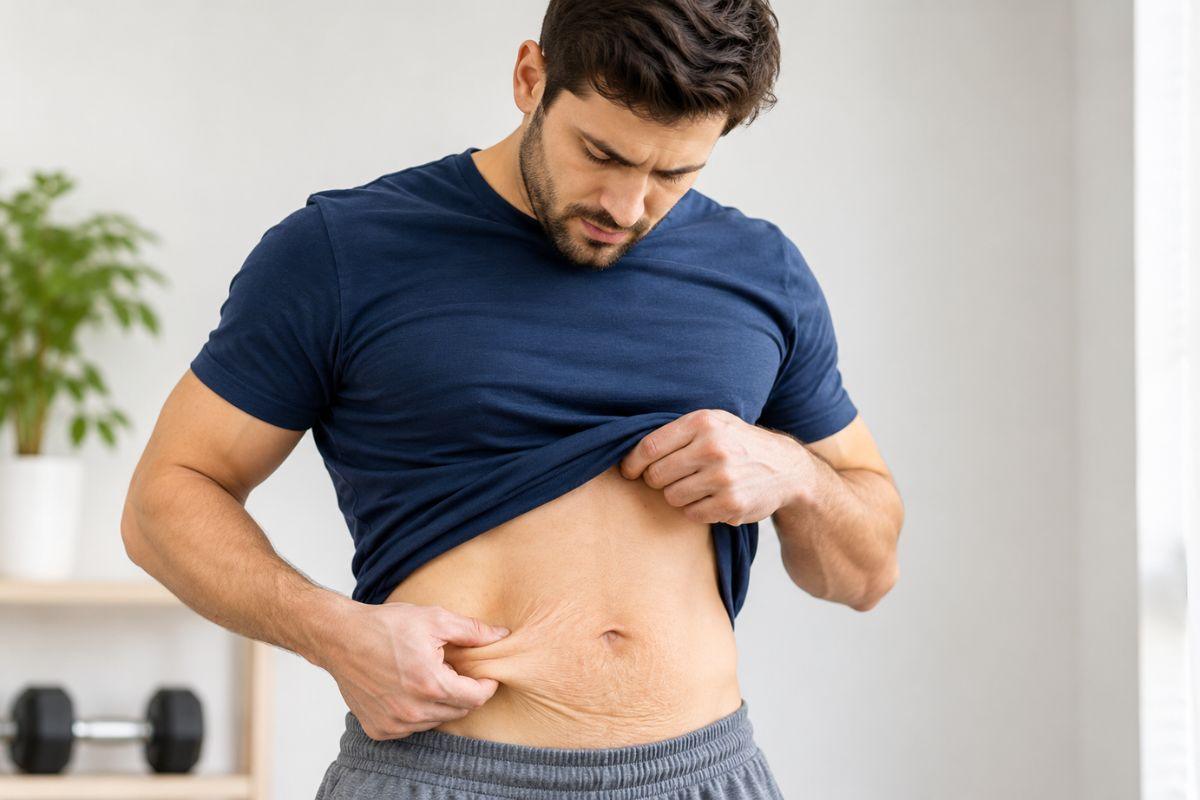
The chest and lower stomach are common trouble spots in men. On the chest, it can show up as softness or slight droop that looks like “moobs” even when you are lean. On the stomach, it is often a loose fold just below the belly button.
Skin Or Fat? A Quick Check
Before deciding what to do, work out what you are dealing with:
Pinch the area. A thick roll you can grip is mostly fat. A thin layer that feels crepey or folds like fabric is mostly skin.
Change position. Skin laxity tends to look worse when you lean forward and better when you stand tall and tense.
Look at the trend. If the area is still shrinking as you lose weight, give it time. If it has not changed in six months at a stable weight, it is probably as tight as it will get on its own.
One more thing to rule out. Firm, rubbery tissue directly behind the nipple can be glandular rather than fatty, and that is worth showing a GP.
What Training Can Do
Strength training helps more than people expect. Building the chest and the muscles of the core fills out the area underneath the skin, which can make mild laxity much less noticeable. Keeping weight stable, eating enough protein and not smoking all help the skin you have.
What training cannot do is shrink skin that has been stretched beyond its ability to recover. Past a certain point, no number of press-ups will change it.
Non-Surgical Tightening For The Chest And Stomach
For mild to moderate loose skin, minimally invasive tightening has become a realistic middle option. One example is Endolift Body at Dr Hass Clinic in Mayfair, where a laser fibre finer than a hair is placed under the skin, under local anaesthetic, to tighten it and refine small pockets of leftover fat in the same session. The male chest and the abdomen are among the areas it treats.
The clinic quotes 60 to 120 minutes depending on the area. Light activity is usually fine within 24 to 48 hours, but heavy training should wait one to two weeks, and a compression garment may be advised. Results build gradually over two to six months as new collagen forms, and the clinic says they typically last two to three years.
It works best for men whose skin still has some elasticity, typically after moderate weight loss of under about four stone. Treatment is carried out by Dr Hasaneen Al Janabi, a GMC-registered doctor and member of the Royal College of Surgeons, who assesses whether the problem is mainly skin, fat or both before recommending anything.
When Surgery Is The Answer
If you have lost a very large amount of weight, or the skin hangs in a fold that does not change with posture, non-surgical treatment is unlikely to be enough. Surgical options such as a tummy tuck remove the excess skin directly. They involve a longer recovery, but for the right person they are the only thing that will make a real difference.
The Bottom line
Start with what you can control: train, keep your weight stable and give your skin time. If the loose skin is still there after six months, get an honest assessment of whether it is skin, fat or gland, and whether a non-surgical option is realistic for you. A good practitioner will tell you if it is not.