You can know the rules of patience and still wonder why a useful card will not budge. It is visible beside the stock, it would fit a column perfectly, and yet the game will not let you take it. Before assuming something is wrong, check how many cards you are drawing.
For a practical comparison, open PlaySolitaire and look at the draw mode above the board. Keep that board beside this guide as you distinguish a card you can see from a card you can actually use. That small difference is the reason Draw One and Draw Three feel like different puzzles, even though the familiar seven columns remain.
The Columns Are Not The Part That Changes
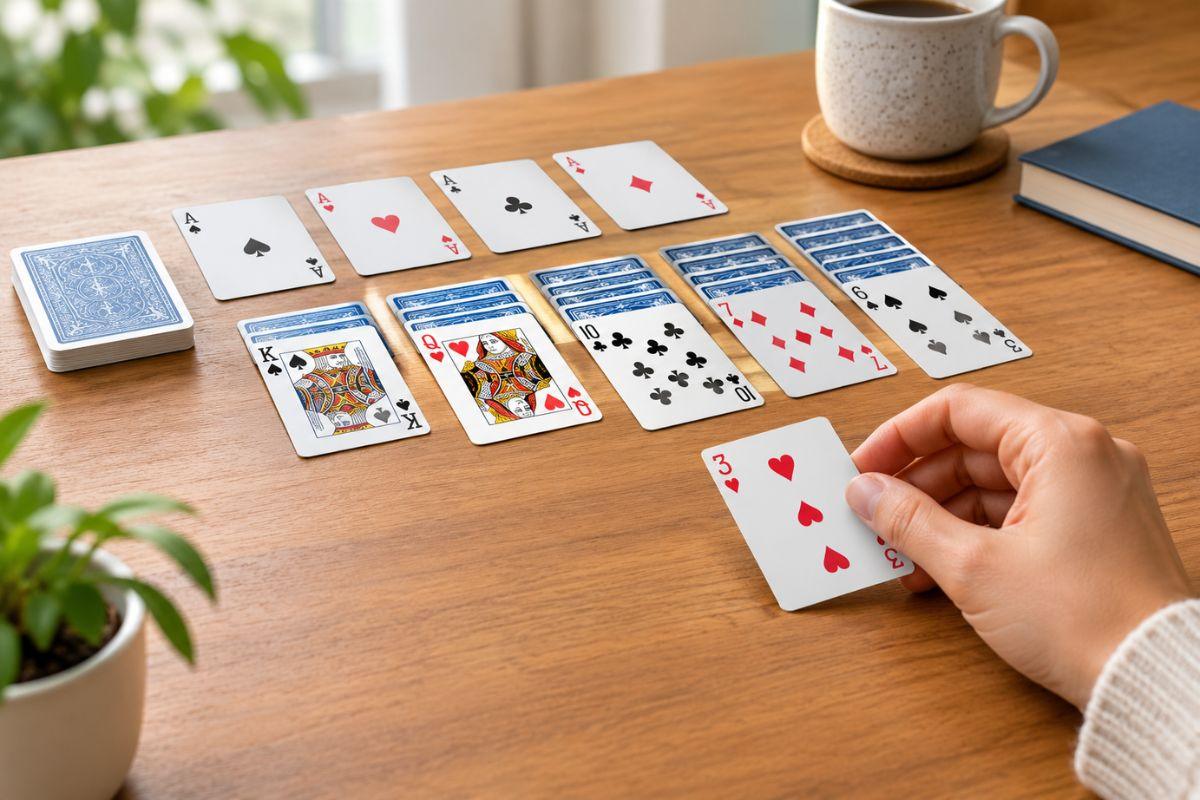
Both modes use the usual Klondike structure. You build descending runs in alternating colours in the tableau, the seven columns on the table. The four foundations build upwards by suit from aces. An empty tableau column needs a king.
Bicycle’s explanation of solitaire describes those foundations and columns. The draw setting changes how cards arrive from the stock, rather than giving you permission to ignore the rules of the tableau. A black nine still needs a red ten beneath it, whichever draw mode you choose.
Keeping that distinction in mind makes learning easier. You do not need to memorise a second set of rules for every part of the board.
Also Read: Top 10 Number Games for Kids Making Maths Fun in 2026
Draw One Makes Each Stock Card Available In Turn
In Draw One, turning the stock exposes a single new card. You can consider that card before drawing again. This makes it a useful starting point when you are learning to scan the columns and recognise possible moves.
Available does not mean immediately useful. A queen might have nowhere to go, while an ace might be ready for its foundation. The setting gives you an opportunity to inspect each stock card in turn; it does not promise that the deal can be finished.
Draw Three Separates Seeing From Using
Draw Three turns over up to three cards at once. Only the top card of the waste pile can be played. Brainium’s solitaire help makes that restriction explicit, and it is the point that often causes confusion.
Consider a made up group containing a red queen, a black jack and a red ten, with the ten on top. Even if a black king is waiting in a column, you cannot reach past the ten and jack to take the queen. You must work with the exposed card first.
If you can play the ten, the jack becomes exposed. If the jack can also move, the queen becomes available. The cards underneath are information you can use to plan, not three separate choices you can select freely.
Also Read: Google Memory Game: What It Is, How to Play, and Why Everyone Is Still Addicted
A Second Pass Is Not Always The Same Situation
As you remove cards from the waste, the remaining sequence changes. On a later pass through the stock, different cards may become exposed at the top of a group. Watching what you remove is therefore part of the puzzle, not just a way to clear a pile.
Do not turn that observation into a rule that every available move must be made. Pause to ask what the move would expose and where that newly available card could go. Sometimes you have a clear reason; sometimes the board does not yet provide one.
Also check the particular game’s recycling rules. Different implementations and scoring options can allow different numbers of passes. A habit learned in one app is not a substitute for reading another game’s instructions.
Choose The Kind Of Decision You Want To Practise
Draw One suits a session focused on reading columns and recognising legal moves. Draw Three adds the question of access: a helpful card may be present but covered. Neither choice needs to become a test of how serious a player you are.
On the browser board opened earlier, each draw mode keeps its own saved deal. Switching modes is therefore not a controlled comparison of an identical shuffle. Use it to notice the difference in decisions, rather than treating two results as proof that one mode guarantees a better score.
The next time a visible card refuses to move, look at its position in the waste. That quick check may explain the problem before you reach for a hint or abandon the deal.
Also Read: Top 10 Esports Games That Dominate Competitive Gaming